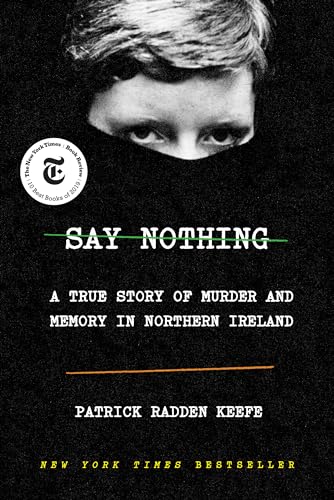
Say Nothing: A True Story of Murder and Memory in Northern Ireland
I’ll admit I had heard only vaguely of “The Troubles” of Ireland and that there was some car-bombing involved by the IRA. So this book served as a nice overview of that period (albeit a little slow to get through - it took me two weeks).
As a little bit of a primer, and for my own notes since I always find the UK to be a bit hard to wrap my head around (what is a country, what is the UK?):
- Ireland was originally a Kingdom (i.e. territory of) England. Technically since England was Anglican, Ireland’s official religion was Anglicanism as well. But the majority of its people were practicing Catholics.
- In the 17th century, the Protestant British colonised the northern bit of Ireland
- Eventually the United Kingdom was formed, including the whole of Ireland
- In 1919 - 1921 the Irish War of Independence was fought by the Irish Republican Army, or IRA. The northern bit of Ireland remained part of the UK, and became Northern Ireland. The rest of Ireland became the Republic of Ireland, which is its own country
The Republican of Ireland was overwhelmingly Catholic, while Northern Ireland had a Protestant majority.
The context of the 17th century colonisation by the British wasn’t mentioned in the book, but it explains why even though Ireland the country is majority Catholic, the northern bit has a Protestant majority. And would also help to explain why Protestants in Ireland are staunchly pro-Britain and pro-UK, since they are actually descendants of British people.
The book begins with a 1969 student civil rights march through Northern Ireland, protesting discrimination against Catholics. Along their march, they are ambushed and attacked by Protestant loyalists (i.e. people loyal to the UK). What complicates things is that the police force of Northern Ireland was also overwhelmingly Protestant and did not do enough to prevent or stop the violence. Notably Dolours Price and her sister Marian Price, future IRA members, were participants in this march.
The Troubles then kick off in the 70s, as the Provisional IRA or “Provos” attempt to unify the whole of Ireland and remove Northern Ireland from British rule. The book focuses on the disappearance of a single mother of ten, Jean McConville. Suspected by her neighbours (in a very Catholic area) for secretly supplying information to the British, she is kidnapped and assumed murdered by the IRA. Which really sets the tone for the book - that the IRA were a ruthless organisation willing to do whatever it takes to help unify Ireland.
What I found interesting is that Northern Ireland’s Catholic/Protestant split is very segregated. Even today there are peace walls that split up Catholic and Protestant neighbourhoods, and schools are split by religion as well. It’s a very strongly held part of their identity. And those that were affiliated to the IRA and its cause were fanatical about it - in cases where they might have done wrong by the IRA, they would accept their punishment, and seemingly even be willing to go to their death (see the case of Joe Lynskey, - another blogger has quoted an excerpt from the book). Not to mention the 10 prisoners who chose to hunger-strike and die in protest of their treatment in jail.
We also learn about Dolours Price (who I learn is the person on the cover of the book. I thought it was a guy, actually) who becomes a key member of the IRA, acting as a driver to pick up people who will be later murdered by the IRA and participating in a car bombing in England (the logic being that most of the violence had occurred within Northern Ireland, and IRA wanted to make their struggle a bit more obvious in England as well).
In the end, the Troubles end in 1998 with the Good Friday Agreement. Ireland is not unified - and so these ex-IRA members are left to wonder, was all that violence worth it? After all, they had carried out acts of violence and murder with the justification of it being necessary for a unified Ireland, and yet were left with seemingly not much to show for it. Dolours Price felt the guilt of acting as the driver for people she had helped disappear - she would recall seeing those that she had driven to their deaths when looking in her rear-review mirror.
The book also touches on the rather botched “Belfast Project” which started out well-intentioned. With the aims of preserving the history of the Troubles, a couple of historians took down oral histories of what happened during the Troubles - basically confessions by ex-IRA members - with the assurances that the tapes would not be released until after they died. When a book was published from two of the tapes (after the two people recorded had passed away), authorities caught onto the fact that a bunch more tapes existed, and attempted to subpoena them.
And finally, coming back to the mystery of the disappearance of single mum Jean McConville, the mystery of her killer has never been officially solved - but the author at the end of the book reveals the name of who he believes to be her murderer.
Gerry Adams, former leader of the political party Sinn Féin (the largest political party in Northern Ireland) has denied ever being a part of the IRA, but the general consensus of historians is that he was one of the leaders of the IRA and quite possibly involved in Jean McConville’s murder. So even though the the Troubles are over and the IRA has mostly disbanded, it has many ghosts that are still lurking.
One “good” thing that did come out of the Troubles is that with the Good Friday Agreement, if a referendum is held and the majority of Northern Island wants to join the Republic, then Northern Island and the Republic of Ireland will finally merge into one country. Interestingly the author points out that the ratio of Catholics/Protestants in the north is growing in the Catholics favour. Not to mention with Brexit, Northern Ireland is no longer part of the EU (as Britain is not) while the Republic is. So we may still see a united Ireland yet.
As other reviewers of this book have pointed out, what makes this book interesting is its choice to focus on a few key characters in the IRA, plus adding in a bit of a murder mystery as well. It makes it a bit more readable than say, a straight recounting of events during the Troubles. It was even turned into a TV drama in 2024, which probably boosted the book’s profile and is how it ended up on my radar as well.
Leave a comment