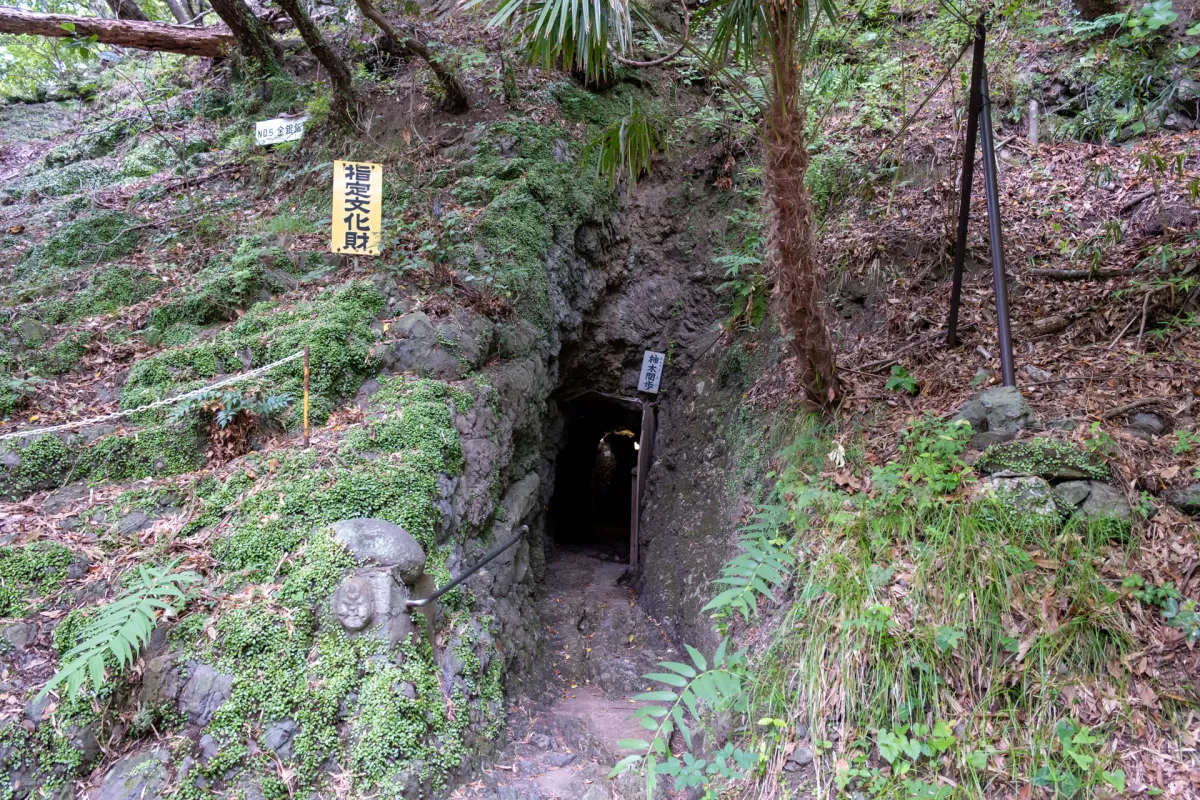
Making our way up the west coast of the Izu Peninsula, we passed by the town of Toi. Toi is most-famous for its gold mine - it was the second largest gold mine in Japan and was estimated to have produced over 40 tons of gold. Today you can visit a museum to tour the remains of its mine. On Google Maps it’s quite easily found as the Toi Gold Mine, but we somehow ended up bookmarking a different gold mine nearby, known as the Gantuki Tensho Kiko (龕附天正金鉱).

We pull up to a tiny parking lot with a reception building, and probably stood outside the car for about 5 minutes debating whether we should go inside (it seemed a little bit dodgy) or whether we should head for the actual museum. I decided we may as well try this one for the experience.
Compared to the actual gold mine museum, which I assume has proper exhibits and so on, this one is instead a tiny mine where you get your own guided tour. I’m not going to recommend you take it unless you happen to be a rock enthusiast with native-level Japanese.

Our tour guide was a fast-talking 87 year old grandpa who could spit out a continuous stream of rock facts. And when I say fast, I really mean fast. Even some of the Japanese reviews on Google mentioned not being able to understand what he was saying so it’s not like it was a language comprehension issue on my part (although I’m sure my non-native skills didn’t help). I could probably only catch 20%, so it was just random words here and there.

Luckily my husband could understand about 80%, so it was mostly him asking the questions. From research online later, it seems he is the owner of this mine, and is one of the descendants of the Yamada family who owned this mine since the Edo period in the 1600s.

He took us through the remains of a late 16th century mining tunnel, pausing to point out features on the walls along the way. There was another couple on the tour with us - I felt a bit sorry for them because they were stuck further back in the tunnel waiting for the grandpa to finish his long explanations (and probably couldn’t even hear what he was saying).


As it turns out, our tour guide grew up in Toi. When he was a kid, the locals knew that these tunnels were here, but they had been long-abandoned. He was warned to stay away from them as they were quite dangerous. In the 1960s he and his father started to clear the area of dirt and re-found the entrance. They were cleaned up, and opened up to the public for tours.
An archaologist of some sort found that the mine walls were meticulously carved and it’s thought that they were originally dug by a craftsman from the Go-Hojo Clan in the late 1500s.
The tunnel continues for 33m. With only one ventilation shaft, the oxygen levels would drop too low if they continued beyond that. There’s a rounded rock neatly placed at the back here as well.

Also the explanation was lost on me at the time, but the “Gan” in “Gantuki Tensho Kinko” refers to “龕” or a Buddhist shrine/alcove - the miners enshrined a deity here when they stopped digging.
The rock hasn’t been here since the 17th century - the guide explained that the rock was placed there more recently (not sure if recent-recent or like in the 1960s) by a TV crew who wanted to make this area seem a bit more “spiritual”. I suppose now that they have left it here, it has become like a museum exhibit in itself.

The pathway out of the tunnels had a much taller ceiling. When opening this cave back up to the public, they used dynamite to detonate a separate tunnel out (nice).

Heading outside, he pointed out to us the buildings on the other side of the road - these weren’t here when he was a child. And he mentioned something about a tsunami passing through. I thought he meant something more recently, but from a Google, it seems like maybe he was referring to the 1707 Hoei Earthquake that caused a massive tsunami, or maybe another one that happened in 1854.

As the final stop of the tour, you’re allowed to have a go at chiselling away at a wall yourself. If you find any gold, you can keep it! (We learned that it is very, very hard to chisel at a wall).


So a little bit confusingly, we had tagged along to a tour that had already started 10 minutes before we arrived. As we finished that one, another pair of people had arrived, so then we swapped over to receiving the first 10 minutes of the tour with those people.
The grandpa headed off in his kei truck (he walked very slowly with his cane so it was funny to see him speed off in the car) and this one was done by a different tour guide, who quite thankfully talked at a more reasonable pace so I was able to take a lot more of it in.

This field was the remains of where they would smelt the gold, which was discovered in the 1960s. In an attempt to preserve it, they first build some sort of wooden fence with a roof - which got blown away (you can see the remains of the wooden fence in 2023 here if you scroll down). So more recently they built these stone walls around it - which now make it pool up with water when there’s a lot of rain (oops).

Finally we got to see a succession of dioramas explaining the gold-making process. They were rather worn, and had seen better days (one Google review mentioned they got damaged by a boar??)


The mined gold eventually gets made into these thin gold bars, known as koban. If you have ever seen the Pokemon Meowth, basically it looks like the gold bit that’s on his head.

It’s a bit hard to read there, but the final diorama is of the Goto Office (後藤役所). The lady explained to us that the Goto (後藤) family were responsible for overseeing the production of these gold bars. And hey, my last name is Goto so maybe I’m their descendant.
This Gantuki Tensho mine hadn’t been mined for over 400 years, but the main Toi gold mine was mined on-and-off until the 1960s. It got to a point where they could find only traces of gold, and financially it was not worth it to continue.
Although I didn’t really understand much of the tour myself, it was still a rather memorable experience. If I ever come back to Toi I will have to check out their other museum and see if it’s any better. The prices for both are about the same (1000 yen) - so when you think about the fact you are getting your own guided tour, it’s a very good deal. Hope the grandpa continues to stay in good health!
Leave a comment