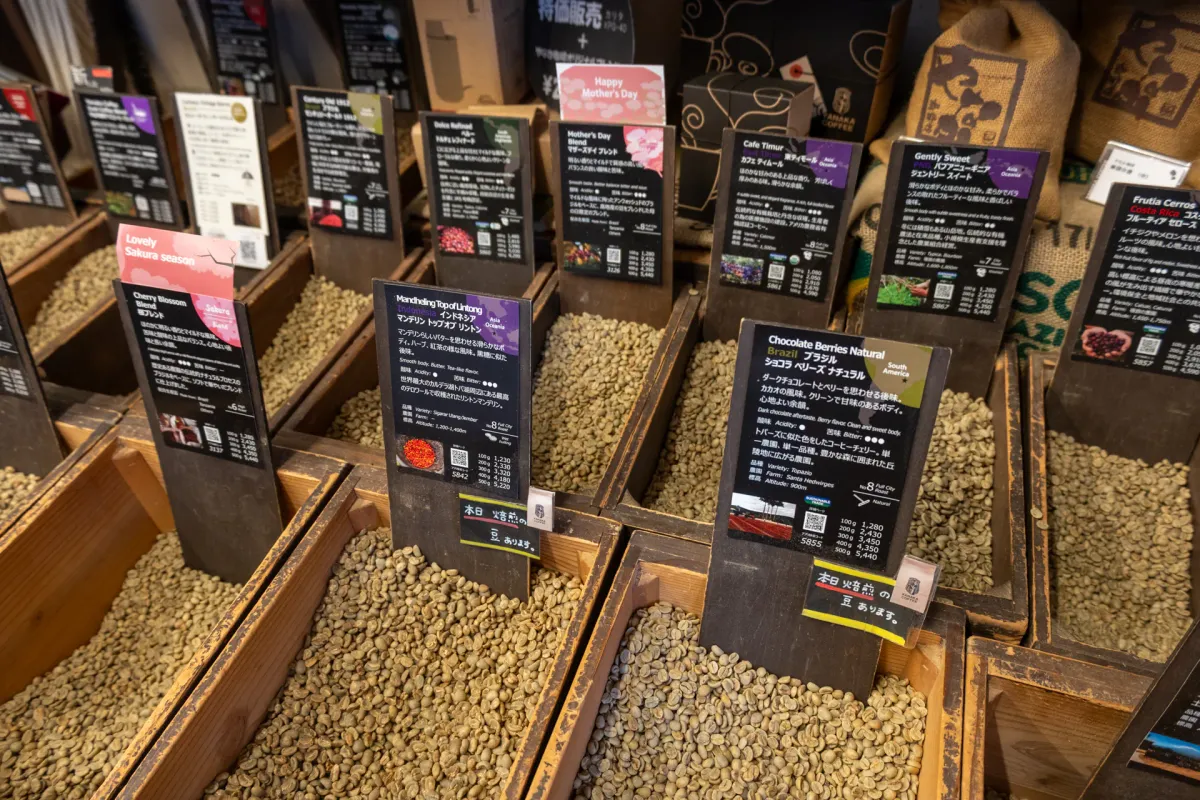
If you’ve ever visited a Japanese coffee shop and found yourself confused by their bean roast levels, me too! I’m still relatively new to the world of pourover coffee, but over the past year I’ve been visiting coffee roasteries around Tokyo and trying out a lot of new coffee beans as a hobby. Recently I had a bit of a confusing experience when it comes to roast level categories, so I decided to dive down the roasting rabbit-hole to try and figure out what sort of beans I was actually buying.
In Japan, coffee bean shops will generally divide their roasting levels into three basic categories:
- 浅煎り (“asa-iri”) or light roast
- 中煎り (“chuu-iri”) or medium roast
- 深煎り (“fuka-iri”) or dark roast
You can see this at a store like Honey Beans in Sugamo, where they stock their “asa-iri” beans on the left, through to their “fuka-iri” beans on the right.

I only ever buy coffee beans in Japan, so I don’t have much to compare against in terms of how other countries might do things - but it does seem like America has a similar setup. They have 4 broad categories, adding an extra “medium-dark” roast as well.
What does each roast level taste like?
Before diving in further, a quick primer on the taste of different roasts if you’re new to coffee beans:
- Dark roasts can cover up the original taste of the coffee bean, so you are tasting the flavour of the roast itself rather than the bean. As a result the bean can taste more smokey. Dark roasts can still taste pretty good so I hesitate to make the comparison - but if you grew up on instant coffee it will have been with a dark-roasted bean, so this might be the closest to what you are used to
- Medium roasts might taste a bit smoother and are generally described as “balanced”
- Light roasts can have quite an acidic taste and are overall quite “light” (for want of a better word). They also might taste fruity or have a floral scent. I think if you are new to drinking black coffee, it is a bit of an acquired taste and it took me quite some time to get used to
All three roasts can be drunken pourover style and can still taste quite delicious - I find that with a darker roast, you will be brewing as low as 75℃, and all the way up to 96℃ for light roasts. If you are looking to drink espresso-style coffee with milk, you’ll probably be using medium to dark roasted coffee. Light roasted beans tend to not go so well with milk.
If you are curious in tasting what light roast coffee tastes like, I would recommmend checking out Glitch Coffee Roasters in Jinbocho. Unfortunately it is quite popular on social media so there can be a bit of a line, but if you are tactical in when you go, you can enjoy a really delicious cup of pourover there.
The 8 roast levels
Separate from this broad light/medium/dark system, there is also a more nuanced 8-level system for describing coffee bean roasts. Ranging from light to dark:
- Light
- Cinnamon
- Medium
- High
- City
- Full City
- French
- Italian
According to one Japanese site, Crowd Roaster, to map these against the original categories you would get:
| Light/Med/Dark | 8 level system |
|---|---|
| 浅煎り (“asa-iri” or light) | Light, Cinnamon |
| 中煎り (“chuu-iri” or medium) | Medium, High |
| 深煎り (“fuka-iri” or dark) | City, Full City, French, Italian |
The one thing to note with this 8-level system is that there isn’t a universal standard of what might make a bean a “cinnamon” roast or a “high” roast. It can very from roastery to roastery, so you can only take it as a rough guide.
Japanese roast level naming can be inconsistent
In trying to figure out how this maps in Japan, I then stumbled across a website for another coffee roasting shop in Ginza called Bongen which categorises their roast levels as the following:
| Light/Med/Dark | 8 level system |
|---|---|
| 浅煎り (Light) | ミディアム (Medium) |
| 中浅煎り (Light-medium) | ハイ (High) |
| 中煎り (Medium) | シティ (City) |
| 中深煎り (Medium-dark) | フルシティ (Full City) |
| 深煎り (Dark) | フレンチ( French) |
| 極深煎り (Very Dark) | イタリアン (Italian) |
As an English speaker using the translated words, the mapping at first glance seems quite odd - you can see from the first row in the table, that “Light” seems to equal “Medium”.
If I were to take a guess, from a Japanese speaker’s point of view they are comparing the words “asa-iri” (浅煎り) and “midiamu” (ミディアム). So this inconsistency might not immediately come across quite as odd to them. Alternatively, it may be because Japanese coffee drinkers traditionally tend towards darker roasts, so from that POV a medium roast is already quite “light” in Japan.
As a second data point this is how North Star Beans, a roaster in Shinagawa, categorises their roasting categories on their website:
| Light/Med/Dark | 8 level system |
|---|---|
| 浅煎り (Light) | ハイ (High) |
| 中煎り (Medium) | シティ (City) |
| 深煎り (Dark) | フルシティ (Full City) |
When I visited their store, they also stocked a “medium” roast, which I would assume makes the table look more like:
| Light/Med/Dark | 8 level system |
|---|---|
| 浅煎り (Light) | ミディアム (Medium), ハイ (High) |
| 中煎り (Medium) | シティ (City) |
| 深煎り (Dark) | フルシティ (Full City) |
Again they seem to follow a categorisation system like Bongen’s where Medium actually means “asa-iri” (浅煎り i.e. “light roast”).

As a further note when researching for this post, I found this rather in-depth article in Japanese on the topic. It looked through 19 Japanese coffee books with a roasting level chart, and found that 6/19 of them followed this classification where “asa-iri” (light) = “medium” (ミディアム). The other 13 did follow the “chu-iri” (medium) = “medium” standard.
Do some Japanese roasteries not stock true light roasts?
This begs the question - does this mean that when you buy an “asa-iri” (or “light roast”) bean from a Japanese store, you might actually be buying a medium roasted bean?
Quite possibly - yes.
I’m not sure I can tell the difference betewen bean roast levels visually, but apparently one way is how difficult you find the bean to grind, and apparently light roasts can be quite difficult. I use a Timemore hand-grinder, and generally it’s quite smooth - you just rotate the top handle in a circle over and over until the beans are grinded. If you’ve ever done it before, you know what I mean.
I have only had one or two experiences where the bean was just so difficult to grind. So I at least know what a difficult grind might feel like! But when I bought the “asa-iri” bean from North Star, for example, it was quite easy to grind which makes me think that technically it is really “medium” roast if you follow the 8-level system. However it did taste quite light to me - so in that sense I was quite happy with my purchase.
Do roast levels matter?
Which leads me to my next point - does it matter if the bean you buy is technically a light roast or not? I saw some good discussion in this Reddit thread. The general consensus was that a) roast levels will vary between roasteries anyway and that b) you should choose your bean based on the tasting notes, rather than the roast level.
I agree with this - I’ve still enjoyed many of the beans I’ve tried in Japan, even if they maybe weren’t a “true” light roast. And they tasted plenty “light” to me - they had more of an acidic taste, and were best enjoyed at temperatures around 93℃. On the other hand, I wonder if the coffee I bought at Glitch (which is apparently actually a light roast) was so delicious because it was a light roast? Then again, I don’t think I could handle having to hand-grind light roasts myself every day.
In conclusion, when buying coffee beans in Japan…
To save yourself the hassle of trying to figure out how each store maps to the 8-level roasting system - I would recommend asking the staff for their recommended bean using “asa-iri”, “chu-iri” or “fuka-iri”, which maps to the light/medium/dark levels. Not all stores use these labels (some use the 8-level system), but any employee will understand what you mean as these are very common words in the Japanese coffee world. And roastery staff are always so friendly and keen to recommend you their favourites as well.
In my case, these days I quite like the lighter roasted beans, so I will ask the staff for their “asa-iri” recommendations.
Most roasteries also have tasting notes on the bean, plus a sample you can whiff, so my second recommendation would be (as Reddit suggested) to choose the bean based on your personal preferences - maybe you’re not a fan of citrusy notes, so you might want to stay away from those, and so on.
And my third and final recommendation would be (if you have the time) to try a lot of shops, and a lot of beans! Most shops let you buy in 100g increments so in that case I might buy 2x 100g bags to take home. It’s always fun to do a taste comparison between two beans as that makes the differences between each a lot easier to distinguish.

Hi, I'm Emma!
I'm a long-time lover of coffee - back in Sydney my go-to drink was always a soy cappucino. After I moved to Tokyo 4 years ago, I discovered the wonders of pour-over coffee and now I'm always on the lookout for new coffee beans to try. So far I've checked out 31 coffee shops and roasters here in Japan.
If you found this post useful, you can also show your support by buying me a coffee ☕
Comments
I live between three wonderful coffee growing regions in Mexico. Chiapas to the South, Oaxaca's Pluma de Hidalgo to the West, and Veracruz to the east. In most regions, we simply have three categories of roasting: light (or cinnamon, due to the colour), medium, and dark. Though, when having beans roasted for you, you can specify the exact temperature and doneness you want.
We have exceptional coffee coming out of Veracruz right now. My preference is medium roast bourbon (robust with lovely chocolate and vanilla hints) or a lighter geisha honey (sweet, a little acidic, and fruity).
Super happy to see coffee culture thriving in Japan beyond the monocultured hipster cafe :) looks amazing!
Ooh thank you for your comment! I love hearing about how other countries do coffee. It must be amazing to actually live in a country that has its own beans!! I will have to try those two you mentioned - somewhere in Japan must probably stock them :)
Leave a comment