As part of my life list at 30, I mentioned how I wanted to get into some sort of arts and crafts. Recently I was watching this fashion YouTuber, and in one of her videos she featured a sweater she had knitted. It was such a nice-looking sweater that I decided I wanted to be able to learn how to knit like that too.
Of course she’s been knitting for multiple years so I don’t have any grand plans on pulling off a sweater right away. But I figured for now I would at least learn the basics and see how I go. One of the beginner videos I had seen recommended was this one on knitting a scarf, so I decided that would be my first project.
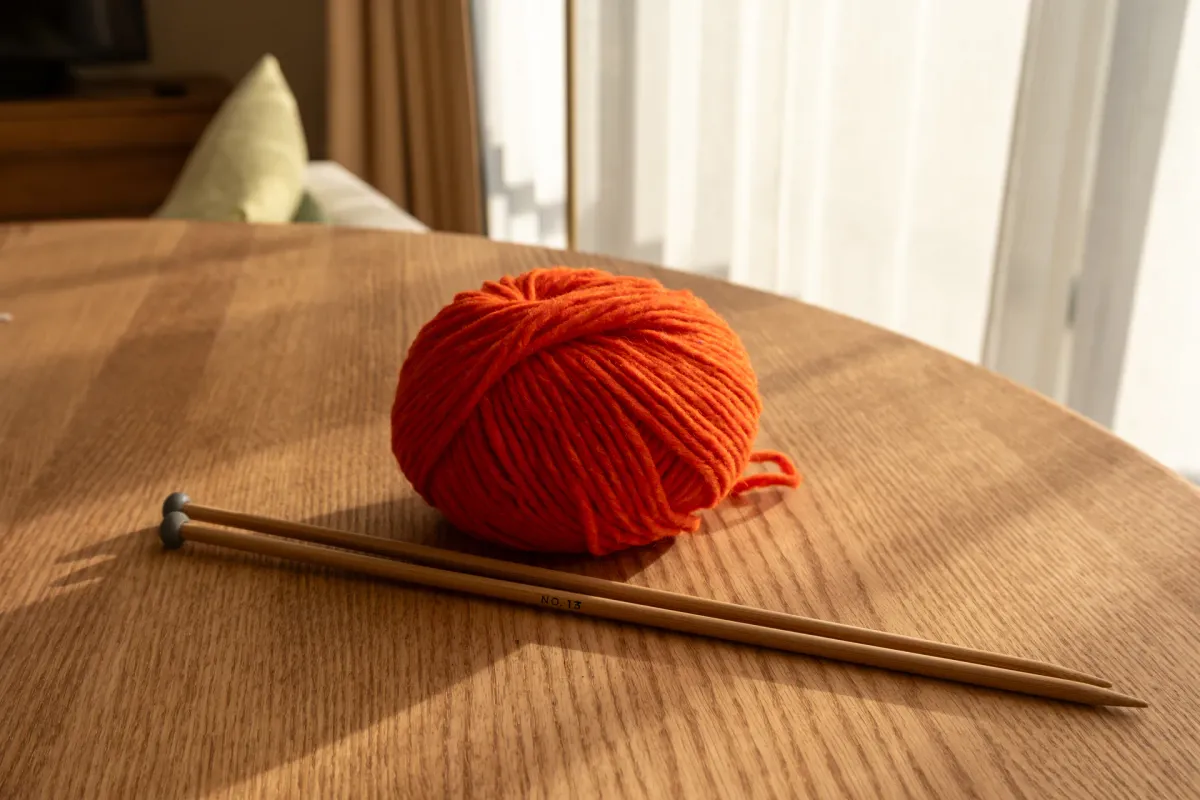
I bought a ball of yarn, and some bamboo knitting needles (if you’re living in Japan, I went with this online store called Daruma Ito). Yarn corresponds with different knitting needle sizes, so in this case I went for size 13 (or 6mm) knitting needles.
I probably went too bougie for my first go at knitting and got some proper wool yarn. But I figure if I’m going to knit something that I could actually possibly use at the end of it it may as well be good quality. And if you compare it to the price of movie tickets for example, it is still pretty good value for money.

With my ball of yarn and knitting needles, I was off. At first, there was a lot of re-watching of the beginner’s knitting video as I tried to figure out how to “cast on”, and the a mishap where I was a bit too forceful with the yarn and I ripped it clean off (oops).
But once I got going, it was fairly easy to just go back and forth and add new rows. Of course I was making a lot of mistakes as I went, but I figure this scarf is more about practicing the mechanics of knitting rather than knitting something perfect so I decided not to undo any of it.
As I kept going though, I started to realise how much there is to learn about knitting. Turns out the video had taught me “English-style” knitting, but there’s also Continental style and Portuguese. All produce the same output, but the key difference is which hand you hold the yarn in as you knit. And you can see plenty of Reddit arguments about which style is faster or better, which reminds me of how programmers like to argue over tabs and spaces.
And for an additional bit of lore, I even learned from a YouTube comment:
“I was never allowed to do continental, because that’s how the Germans would knit. It was a way to distinguish if a woman was on the right side or the wrong side. I know it’s been 80 years since the war started and yet I still feel reluctant. I remember my grandmother hitting me awfully hard on the hand when knitting continental as a little girl. It seems so much faster, but also more complicated to where and how you put your needle in the stitch.”
I switched to Continental style after about 10 rows of knitting, since I found the English method to be very slow-going and I was curious to see if Continental was any better.
I’m not going to lie, the first few rows on Continental was very frustrating since it felt like I was going back to 0, but once I started to get the hang of it, things did feel smoother than the English method. It almost seemed like things were going well.
But somewhere along the way I ended up falling into a common beginner’s trap and started adding extra stitches… and nearly doubled the width of the scarf before I noticed.

It seems the only way to fix this mistake is to undo all your work (delightfully known as “frogging”). I decided instead to just reduce 1 stitch per row (via k2tog) to get it back to a more gradually scarf-like width.
Finishing off my ball of wool, you can start to see I was getting pretty consistent towards the end:

Of course if you zoom out and view the whole thing, it is an absolute abomination:

In hindsight, of course I should have unpicked the whole thing and started over when I realised I had been adding stitches, but undoing all of my progress like that was too sad. And hey, at least you can see my knitting progression.
The technique I had used is the most basic one - known as “knit” stitch. If you continuously do rows and rows of knit stitches, the resulting pattern is then called a “garter stitch” (a little confusing that both are known as stitches).
Another common pattern is the stockinette stitch, which is done with 1 row of knit stitches and then one row of another type of stitch known as a “purl”. I figured it would be worth practicing that as well so I decided to frog (or unknit) my scarf so I could give that a go.

It took a while (30 minutes of watching a YouTube video and getting increasingly annoyed about how hard it was) but I got the hang of it, I think! Even with purling there’s a number of techniques you can use - I went with what’s known as a “Norwegian purl”.
Next up - I’m thinking about how I can re-use this ball of yarn. I might try out this Japanese wave pattern. After that, I’m going to buy some more yarn and give knitting these gloves a go.
Leave a comment