Continuing on with my Yamanote line walk series, this time we walked between Osaki and Takanawa Gateway station. Takanawa Gateway is the first new station on the Yamanote line in 49 years, so I had been curious to see what all the fuss was about. Along the way we would pass Shinagawa station, which had a coffee shop I wanted to check out.
We did this walk on one of the days of Golden Week, which is one of Japan’s busiest holiday periods. We had considered going somewhere in Japan (maybe camping) but it becomes hard even to get a campsite reservation, as everyone heads out of Tokyo to do some domestic travel, or heads back to their hometowns to visit their relatives. So we decided to take it very low-key this year and stay home.

Osaki station is a fairly quiet one, at least on a public holiday. I did see one coffee roastery that caught my eye, but unfortunately it was closed due to Golden Week (drats).

Moving on, we decided to head in the direction of Shinagawa station. I will say the stretch from Osaki station is very quiet. I got the sense the area is a bit more of a business area? We did pass a tiny little garden called Gotenyama Garden - complete with a waterfall.

For the train enthusiasts, there’s some opportunity for train watching as we headed along the train tracks towards Shinagawa station - there were plenty of shinkansen going by.

We also took a detour to Shinagawa shrine, as we saw it was nearby on the map.

Interestingly this had a connection to our last walk between Ueno and Nippori. It’s one of the 10 shrines belonging to the 10 Shrines of Tokyo (Tokyo Jissha), a list of shrines selected by the Meiji Emperor. Nezu Shrine which we visited on our last walk was also one of the 10, so now we have visited 2 of the 10!

There was a man-made pile of rocks, known as the “Fuji-zaka” (Fuji hill). It’s a faux-Fuji meant for worshippers that cannot climb Mt Fuji itself.

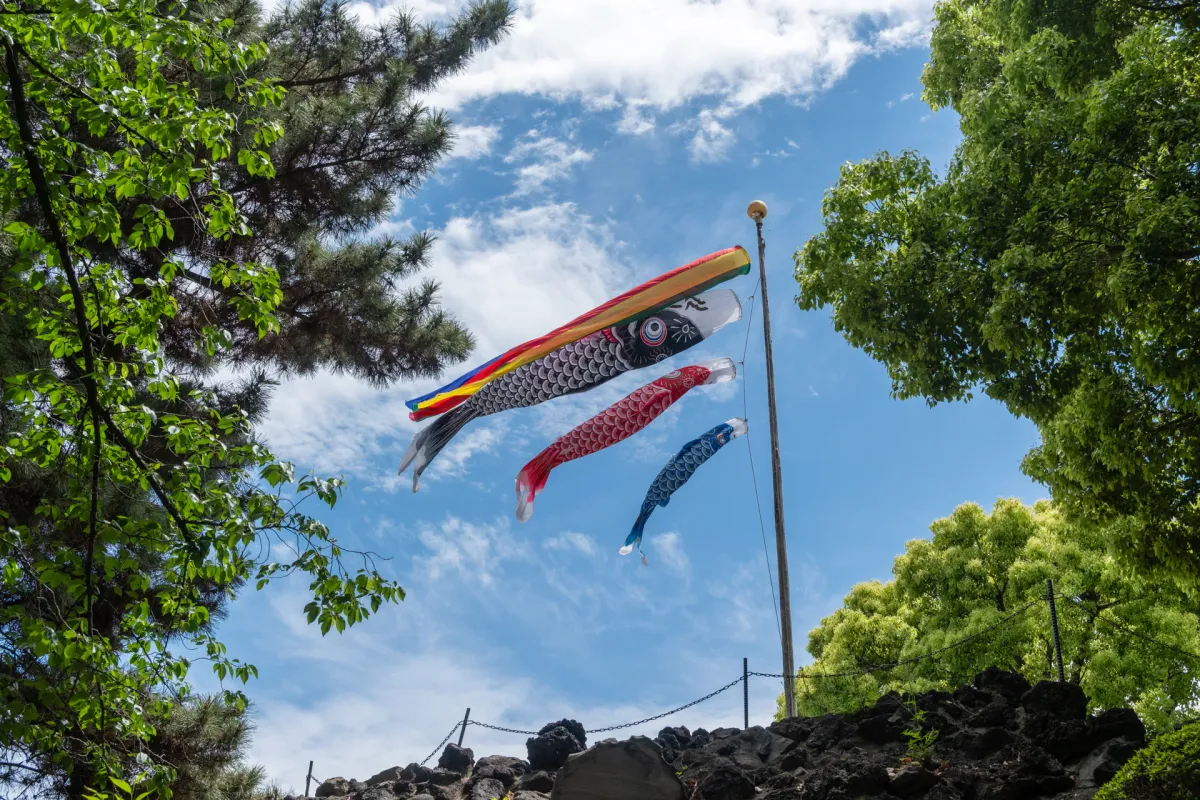
There’s a frog statue at the bottom of it, and delightfully a pun - “buji-kaeru”. It’s a combination of “Fuji” and “frog” - and means “return safely”. At its peak were some pretty koinobori.

It would have been around the Children’s Day national holiday when we passed by, which is when these are traditionally put up. The big black koi is the dad, red one is the mum, and then the blue one is the child.
Next stop on our walk was a detour to Tennozu Isle.

It’s a bit like Odaiba - a man-made waterfront area - but on a smaller scale. There were a couple of fancy-looking warehouses, a brewery, and the modern art “WHAT” museum. Unfortunately the area was super windy so we didn’t stick around too long.
Heading back inland, and away from the wind, we headed for this coffee shop near Shinagawa station that I had been wanting to check out called KAIDO books&coffee.

As I learnt later, it sits along the Tokaido, a major route connecting Kyoto and Tokyo during the Edo period.


I quite liked the vibe of this street!

With one of my main objectives checked off for the day, next stop along the walk was Shinagawa station. As we started walking towards it, we stumbled upon a coffee bean roastery called NorthStar Beans. The exterior is rather unassuming but this was such a nice find!

I feel like this made the whole walk worth it - we definitely wouldn’t have stumbled upon it otherwise.
And just past NorthStar Beans, a great intersection for train fans.


Actually it took forever for the barriers to come up, the trains kept on coming.

Shinagawa station is housed in quite a huge building. I’ve been to Shinagawa many times before, but actually this might be my first time visiting the outside of the train station. It’s a big hub for a number of train lines, and often you’ll transfer onto the Shinkansen from here.

From the outside though, you can’t really see any evidence of this - actually I was surprised by how quiet Shinagawa station felt (relatively speaking) compared to the hustle and bustle of somewhere like Ikebukuro or Shibuya.

From here it was onto our final destination of the day - Takanawa Gateway. Rather than heading along the road, we took a detour through Shibaura Central Park.


Takanawa Gateway is still partially under construction so to get from the park to the station, you had to head into this underground tunnel spookily named the “ghost tunnel”.

It’s a bit of an adventure - near the end the tunnel shrinks to a mere 1.5m in height so you have to duck to make your way out of it.

As we approached Takanawa Gateway, we passed the MoN, or Museum of Narratives. The structure is built by famous architect Kengo Kuma (actually he did the Starbucks Roastery as well). I think it only opened this year. Although overall it has a 4.1 star rating on Google Maps, there were some strong negative ratings which seem to suggest that it’s still a bit lacking in exhibitions.
As soon as you approach the station, it suddenly starts to get a lot more crowded - I’m sure quite a few people just get off at this station for the sole purpose of checking it out.
Takanawa Gateway is a bit of an interesting station, because they didn’t build this because there was something already to do here. They rather built it with the aim of adding something to do here after the fact. I think it was originally planned for the influx of tourists during the 2020 Olympics (which obviously didn’t pan out).
Part of the concept of this station is supposed to be it’s like a “city of the future”.

The moving vehicles I understood, but I wasn’t quite sure what this guy was for.

From Googling it later, it says that it’s supposed to be a food delivery robot. What I found most amusing about it though was that it had a bodyguard - this guy holding a game controller and strolling behind it.

Takanawa Gateway as a station started operations in 2020, but the actual area - shops and all - only had its grand opening on the 28th of March 2026 so it’s still very new.
My overall verdict is that this place might be quite good to visit in 5 - 10 years if they continue to build up the stores and the area around it, but at this stage it’s a bit too new and empty to be worth visiting.

All-in-all, a nice day to spend a day out. I’ve now covered 8/30 stations on the Yamanote line.
Leave a comment