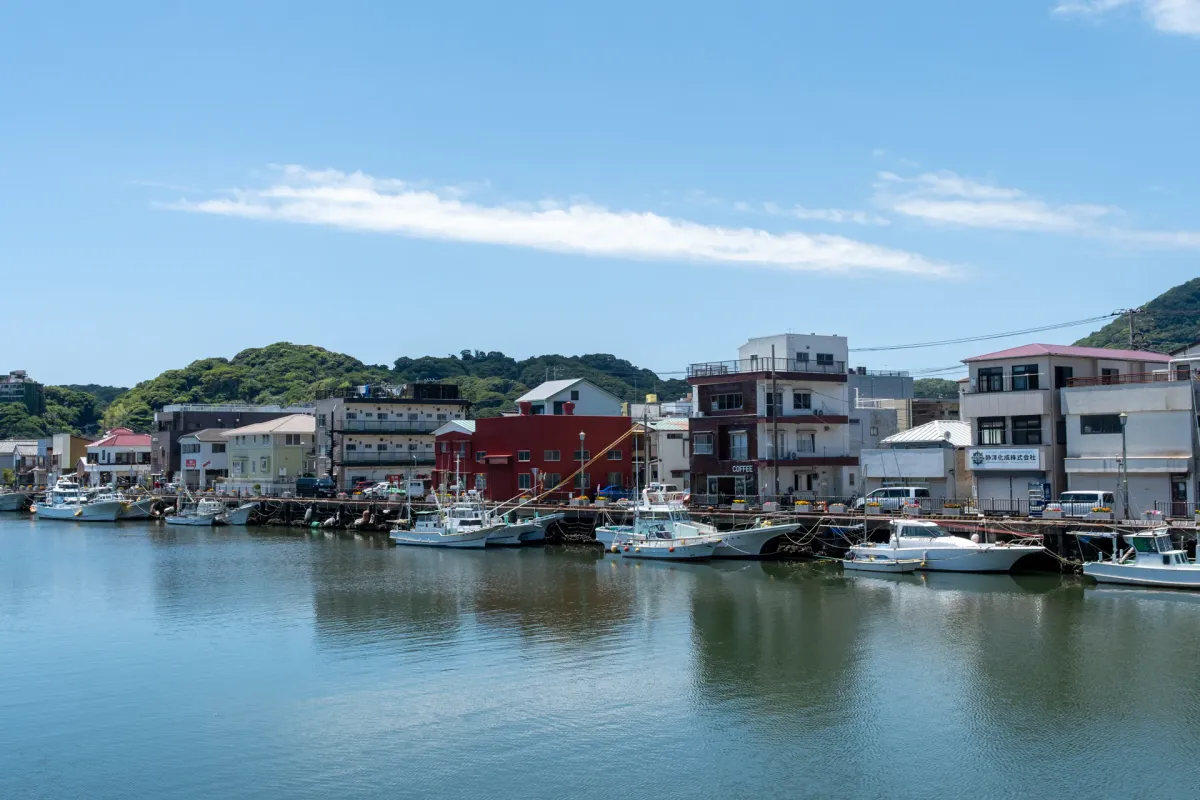
Shimoda is a town on the south-eastern end of the Izu Peninsula. To be honest, the only reason we planned to stop here was that I had spotted a cute coffee shop on Google Maps. As it turns out though, Shimoda has a rather huge claim to fame as being the first port town in Japan opened to trade with the United States.
I was left feeling rather bemused by Shimoda. Commodore Matthew Perry sailed in with his steam-powered black ships and essentially threatened Japan into opening its borders in 1854. But the town seems to have embraced this part of its history rather wholeheartedly - there’s a “Perry Road”, a bust of the man, and other memorials in recognition of this significant event.
Our first sign of this was at the roadside station or “michi-no-eki” which was flying two flags of Japan and America.

Nearby there was a ship cruising in the harbour, named the Susquehanna after the USS Susquehanna, one of the black ships Perry used to sail into Shimoda.

After checking out the Coffee House Kahikan, we headed towards what seemed to be the most interesting spot on the map, a spot called “Perry Road”.

My first impression of Shimoda is that it was really, really quiet. One of the streets that we walked down maybe once had more open stores, but everything seemed to be shuttered up. Of course, our visit to the coffee shop proved that there was some liveliness if you knew where to look, but there wasn’t much evidence of it on the streets.
I think partly this might just be the area we were walking through - if you head towards the train station there were some big supermarkets and the like.


Along the way we passed an example of a “Namako wall” (or “sea cucumber wall”) which was a style of tiling used in the 19th century.

We came to “Perry Road” which was a rather idyllic tree-lined canal, and maybe a nice photo opportunity. Even so, it was still a very quiet street.

I’m also realising that Shimoda is famous for its beaches - so it might just be that the area sees the peak of its tourists during summer, and we were a bit too early for that.

On the corner was a rather cute coffee store called Pepe which was unfortunately closed, even though it was a Saturday.

What drew our attention was it seemed some famous celebrities had stopped by.

The top photo shows a photo of a guy from a boy band called SMAP (my mum loved them back in the day). While the bottom one is of a Japanese comedian on a TV show promoting food spots around famous cherry blossom areas in spring.

Up a side street was the Choraku-ji temple where the Treaty of Shimoda between Russia and Japan was signed in 1854. I suppose the Russians got jealous of America and wanted to get in on the fun.

There’s also a “30-pounder carronade” on display from 1829, although it’s not really explained where it came from.

Plus the Old Sawamura House, which is a preserved house with the same sea cucumber tiling pattern.


Out on the canal, what started as a rather peaceful scene with a duck and her ducklings turned into some real drama as a couple of the adult ducks got into a fight.


Still not feeling any less bemused by Shimoda, we checked out the “Admiral Perry’s Arrival Memorial Stone”.

Which came with a little eternal flame and plaque from George Bush.

Our final stop on this random Shimoda tour was the town’s park. We were a couple of days early for its ajisai (hydrangea) festival but it seemed like some of the flowers were already in full bloom.


Among the ajisai was yet another plaque from a US president, this time Jimmy Carter.

I found a longer speech where it seems the plaque took its quotation from. I then got side-tracked because it mentioned that Jimmy Carter had a favourite yakitori place. Which then led me to this archived New York Times article from 1981 by Richard Halloran which mentions that the shop was named Kushihachi in Roppongi. Aside from that one Tabelog link though, I couldn’t find any existence of the store currently so it seems that it’s now long-closed.
Heading further into the park was what was described on the map as “Monument of Japan’s Opening to The World” which all sounded rather fancy.

There are some quotes written on the plaques:
- On the right side, General Douglas MacArthur selected a quote from Perry - “I have come here as a peacemaker”
- On the left side, William J Sebald selected a quote from Townsend Harris - “My mission was a friendly one in every respect”
- And then down the middle, it says “開国記念碑” (a similar meaning to “Monument of Japan’s Opening to The World”), which was written by Shigeru Yoshida
Those are some… choice quotes.
Given that it’s MacArthur choosing a quote (who oversaw Japan for a time post-WW2) you can guess it’s a post-WW2 monument, and yep, it was unveiled in 1954.

Then there is another plaque below that that seems to have been added in 1960 -
- 「日米修好の基礎は、下田に於て築かれた」or “The foundation of Japan-US friendship was built in Shimoda.”
From the park, you can also see out to what is probably Mt Nesugata, Shimoda’s local mountain (elevation 200m). Might be nice if you wanted to get a view overlooking the town.

There was also a bust for Shimooka Renjo who was born in Shimoda and became one of the first professional photographers in Japan.

Heading back towards our car, we passed some more black ships.


The Ajisai festival in the park we visited kicked off on the 1st of June, and I did see food stands being set up in preparation for that. With the heavy rains from the recent typhoon that rolled through on June 3, it seems a landslide closed off the train line down to Shimoda. Which is really unfortunate - it did feel like the town needs all the tourists it can get.
As a final note, there are paid parking lots available in the town in the range of 100 yen per hour. But if you just walk to the Michi-no-eki outside of that there is plenty of free parking.
Leave a comment