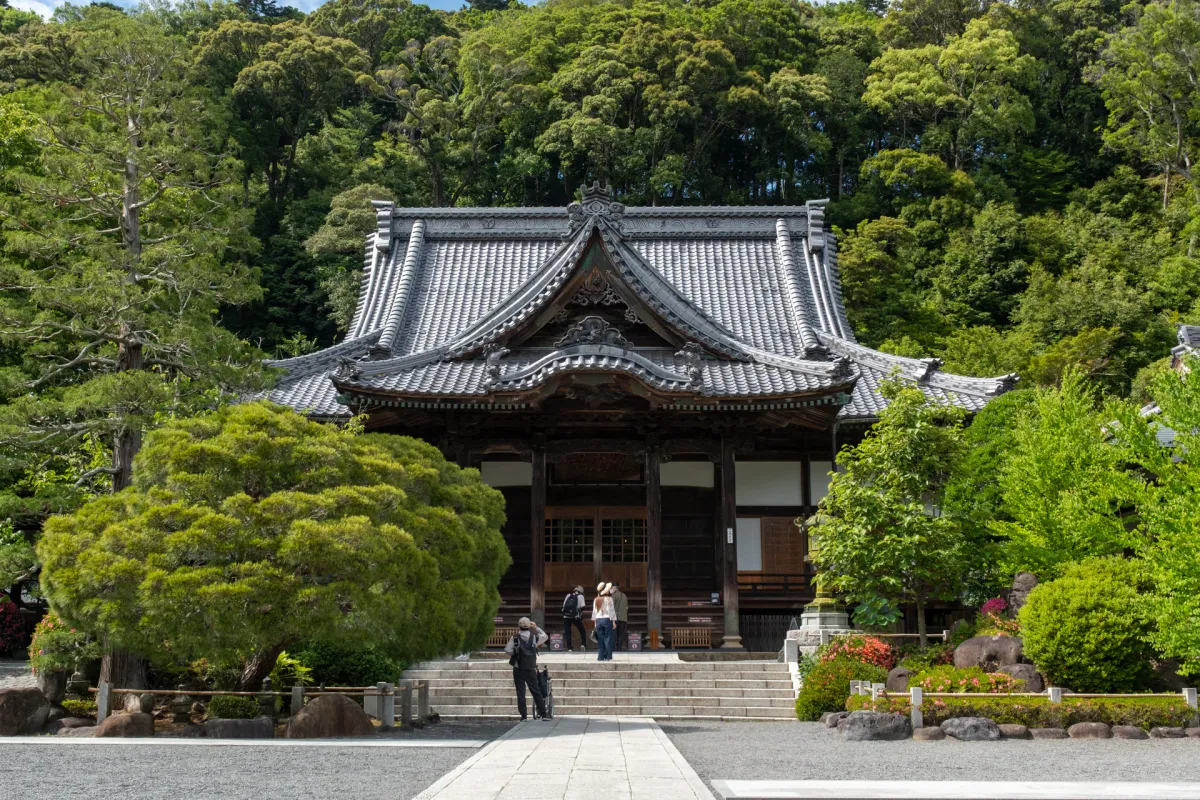
The hot spring town of Shuzenji was our final stop on our Izu road trip before heading back home to Tokyo. To be honest, we weren’t really planning on checking it out, save for the fact that our return route basically passed by the town anyway, so then we figured we may as well stop.


There was supposed to be a coffee roaster open here called Koto where you can roast your own beans - unfortunately it seemed it had closed early. Otherwise, the town is home to a Pokemon manhole.

It’s only one of 5 in Shizuoka Prefecture, and the only one in Izu. As for why it’s panda-themed, it’s because there is a small bamboo grove that you can walk through.

Shuzenji takes its name from the Shuzenji Temple, which was founded in 807.


The temple was founded by Kobo Daishi. A monk born in the 8th century, he’s said to have travelled around Japan, striking the earth with his walking stick to make hot springs with restorative properties well up.

A couple of years ago when we visited Tokushima’s Mt Ishizuchi, we came across another one of these “Kobo water” spots. There’s said to be over 1000 water spots, stretching from Aomori to Kagoshima. Either Mr Kobo was very prolific with his walking stick, or the cynical side of me says that probably some people got in on the action by pretending their water source was one of the “Kobo water” spots. Considering Kobo is said to have founded this temple though, Shuzenji can probably claim theirs is the real deal. (Although research tells me that Kobo founded this temple “according to legend” which makes me pause a bit).

Right next to the Shuzenji Temple is the Hie Shrine. I sometimes forget which is which but temples (or “tera”) are Buddhist, and shrines (or “jinja”) are Shinto. This was also founded by the same Kobo Daishi. I found that a little confusing - I would’ve thought a shrine and temple might be competitors to each other, but pre-Meiji era shrines and temples were more intertwined, and the shrine was a “chinju-sha” placed to guard the temple from evil spirits.
Then during the Meiji era Shinto and Buddhism were forced to more clearly split, and the shrine and temple became two distinct entities.

There’s also a “husband and wife” cedar tree next to the shrine, which is said to be over 800 years old.

Overall Shuzenji felt a little bit touristy - although on the upside it wasn’t too crowded. I can see why it’s sometimes called the “Little Kyoto of Izu”. There was definitely no free parking here, but at most you’ll pay 500 yen for the day so it’s reasonable. We only had a very quick walk through of it, so it might be nice to stop here for a bit longer and enjoy lunch or a snack. There is also the Shuzenji Niji-no-sato which has little British and Canadian-themed villages (plus a working steam train!) which might be fun.

Leave a comment