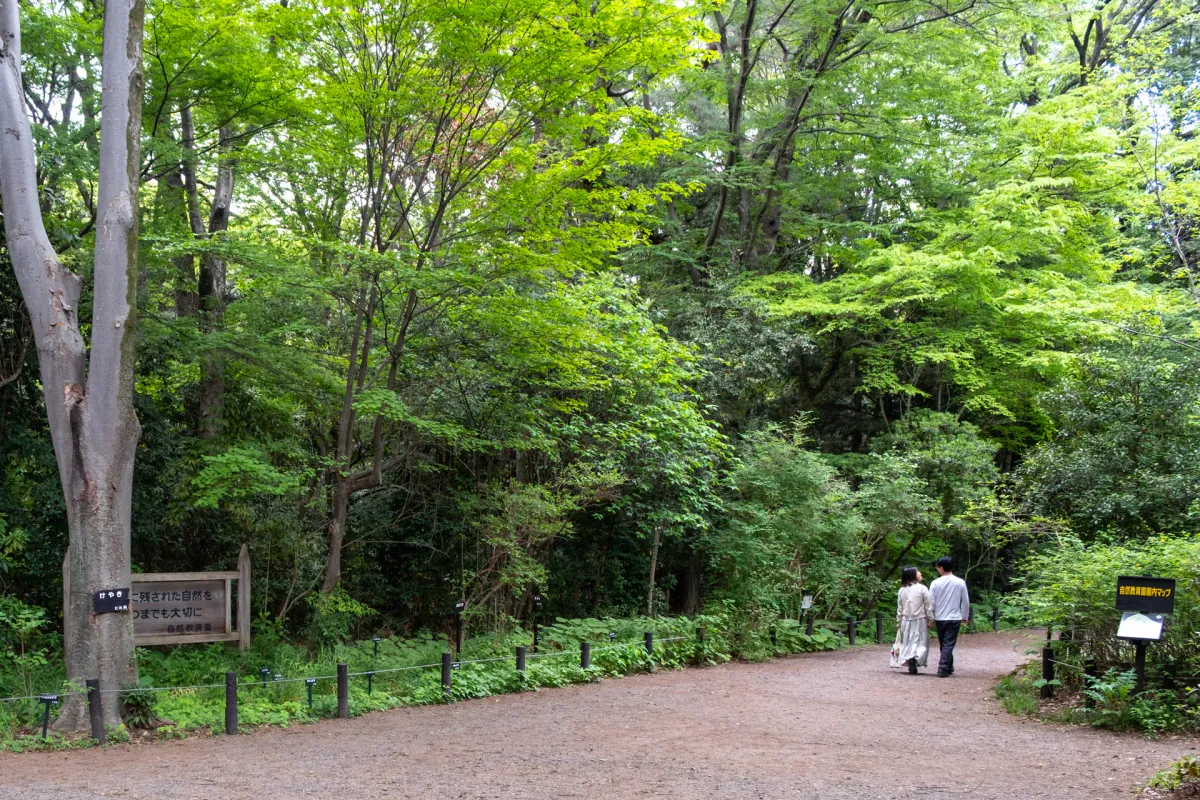
I found myself in Meguro a couple of weeks ago, and along the way decided to stop by the Institute for Nature Study as I heard it was a good birding spot. Looking at its splotch of green on Google Maps I’d envisioned some sort of small park, but it’s actually more like a dense, overgrown jungle. Which I assume must be pretty good for nature studying.

Quite naively I thought I might spot a bunch of cool birds like I did when I visited Shinjuku Gyoen earlier in the year, but alas it was very hard to spot anything at all. The Institute has a walking track that you can spend about an hour walking through. You can definitely hear plenty of birds, but spotting them is another matter.

The first bird I spotted was a brown-eared bulbul screeching its head off, plus there were some mallards out on a small pond.

There were many large-billed crows making themselves known in the trees overhead as well.

Really, all I needed was a regular pigeon to round out this “most common birds of Tokyo” series (actually I haven’t logged them on my birding log yet so I will have to rectify that) but I did spot its fancier cousin the oriental turtle dove, of which there were a couple rustling around in the leaf litter.

Finishing off my loop of the Institute and passing by another lake, I spotted some turtles.

The one slightly more rare find was this pale thrush hiding out in the bushes by the edge of the lake.

The last (and only time) I’ve spotted one of these guys was also by the edge of a lake at the Shinjuku Gyoen, so I wonder if that’s where they like to hang out.
There were also quite a few flowers blooming at this time of year, plus the occasional butterfly flitting about.


Upon reflection, I’m thinking if I’m planning on heading somewhere to bird then I should find out what time of day, or which season, is best for birding. Or to make use of a birding website like eBird or ZooPicker (which seems to be the Japanese equivalent). I suppose it’s similar to checking out a hike’s trail conditions on YAMAP which I always do before my hike.
From a quick Google, in this case it looks like I would have had better luck in the winter months, plus coming first thing in the morning instead of in the afternoon like I did. One bird I really want to spot next winter is the common kingfisher, which could be a visitor to these lakes here so I’ll have to come back.
Heading back to the park entrance, there’s a small information centre where you can see the display of what birds, flowers and butterflies are able to be seen in that month - quite useful!

Plus a small taxidermy display of some local birds.

Right in the corner information centre there’s a 10 minute screening on Eurasian goshawks (オオタカ).

Unfortunately it’s only got Japanese subtitles so I’m not too sure how interesting it is if you can’t read it. I hadn’t meant to watch the whole thing, but I found myself sitting down, engrossed. For a number of years now, the same pair of goshawks have been raising their chicks in the Institute. Helpfully they re-use the same nest nearly every year, so in more recent years the researchers have been able to get overhead cameras set up to directly monitor the eggs and their hatching process.
The first year the pair was tracked they didn’t do a very good job of raising their young (I forgot if any survived - I think the eggs got eaten). But as the years go by their success rate goes up. The video has some dramatic turns, with a battle scene where they fight off a snake (!) that climbed up the tree plus some sort of small badger-ish animal also intent on stealing their eggs.
Access to the Institute for Nature Study
The Institute is about a 10 minute walk from Meguro station - which hosts a number of different train lines - plus it’s also quite close to Shirokanedai station if you’re coming on the metro Namboku or Mita lines.
Admission is 320 yen, payable via cash to a ticket machine at the entrance.
Comments
Thanks for the post - it's wonderful that Tokyo has these patches of green here and there. As for finding birds, they will find you as soon as you plant your vegetable patch. The bulbuls are currently gorging themselves on my wife's blueberry bush .... : (
I've got the beginnings of some cherry tomatoes and basil happening at the moment, hopefully I can enjoy it before the birds do! Silver lining, I'm sure you could get some pretty cute pictures of the bulbuls.
Leave a comment