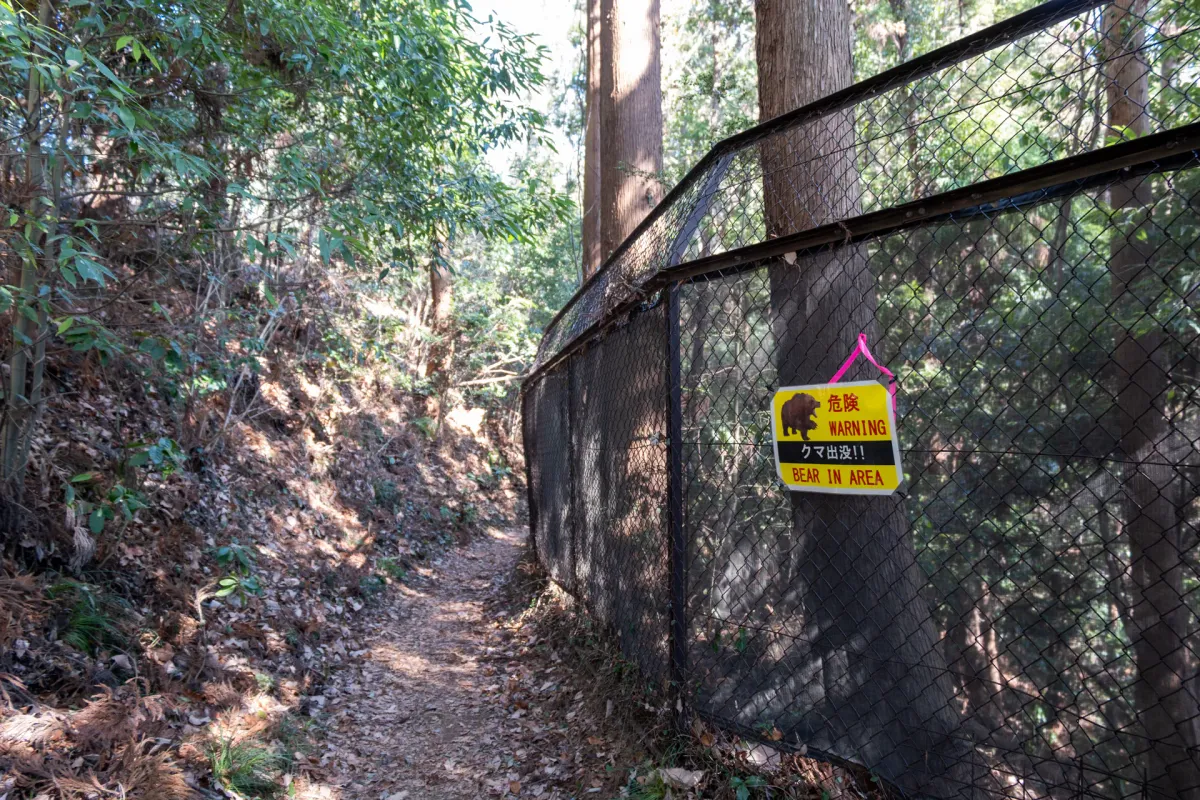
In recent years, the surge in bear attacks in Japan has been making the news. And if you want to go hiking in the mountains of Japan you’ll quite reasonably want to know - is it safe, or should you be scared of bears?
In 2025, 238 injuries due to a bear attack were reported, including 13 deaths. Although this number is a record high, the majority of these are non-hiking related incidents. And if you compare that number to the millions of hikes that people go on in Japan each year, the probability of you actually being attacked by a bear on the trail is still statistically very, very low.
But even if you know logically that the chances of a bear attack are slim-to-none, human brains aren’t always logical - so it’s still only natural that you might still feel nervous, especially if you don’t have too much experience with hiking in Japan. Putting statistics aside, hiking is all about what makes you most comfortable, so my personal take on bear safety in Japan is more mental than scientific. It’s no fun going on a hike if you are going to spend the entire time worrying about a bear popping out from behind the next tree.

My philosophy on bear safety
I live in Tokyo and do most of my hiking around here or on the main island of Japan (which is only home to black bears), so this section is specifically regarding black bears.
My general feeling is that there’s safety in numbers. Bears are known to be wary of humans - and attacks are thought to be most common when a bear and human accidentally cross paths, rather than a bear specifically seeking out a human. So my first piece of advice would be to hike with at least one other person, preferably a group.

The noise of a group of people walking and having conversation together is surely enough to alert any bears to your presence, not to mention the bear would probably decide against the idea of trying to pick a fight with a group of people.
However, I don’t actually follow this advice myself, and do at least 75% of my hikes solo. So my personal strategy for bear safety is to choose hiking trails where there are going to be other people around.
This isn’t just a bear thing - as a solo hiker I just generally feel more comfortable hiking knowing that I’m sharing a trail with other people. Of course I don’t enjoy it when there are so many people that I never get a moment’s peace, but it’s nice to see another friendly human every now and then on the trail.
Choosing which mountains to hike
So then your next question may be, how can you know which mountains are going to have fellow hikers on them? If you live in Japan and hike regularly, it starts to become quite easy to get a sense for what mountains are popular or not. But if you are not familiar with Japan’s mountains, a couple of easy places to start would be:
- Mountains with a cablecar or ropeway infrastructure: the easiest indicator of a mountain being full of hikers
- Mountains on the hyakumeizan list: many of these mountains are quite popular as Japanese hikers attempt to climb all 100 mountains on this list
Trails tend to be a lot more crowded on the weekend and on national holidays. For hyakumeizans and other popular mountains, I will opt to go hiking on weekdays, as even then there are still enough people around that I feel safe.

However if you are looking to hike a more niche, local mountain, I would recommend the opposite and try hiking on a weekend, to increase the likelihood of other people being around. My personal experience so far has been that for basically any mountain I’ve hiked, I’ve bumped into other hikers on the weekend. The only time I’ve experienced a truly quiet mountain (where I see like one person in 6 hours) has been when I’ve hiked something more niche on a weekday.

If you are still unsure of whether a mountain or the specific hiking course you want to do is popular or not, I would encourage you to download YAMAP, which is the most popular hiking app in Japan. If you search for the mountain you are interested in, you can easily see how many activity logs have been uploaded in the last day / week / month to get a rough sense of how popular a mountain is.
Black vs brown bears

So living in Tokyo, I’m only likely to ever see a black bear. But Japan is actually home to two species of bears:
- The Asiatic black bear, located on the Japanese mainland and the island of Shikoku
- The Ussuri brown bear, only located in Hokkaido
The brown bear is larger and considered to be more dangerous - and so if you are hiking in Hokkaido, you could consider taking more precautions.
Does Kyushu have bears?
If you are familiar with your Japanese geography then you might also realise from the description above that the island of Kyushu (the bottom-most of Japan’s main islands) is actually bear-free. So if you are definitely wanting to steer clear of any possibility of seeing a bear, then hiking in Kyushu may be your best bet.

Brown bear attacks in Hokkaido
Heading up to Hokkaido (home of the brown bear), the statistics show that Hokkaido has seen 70 deaths in the last 37 years to bears. However the majority of these are not to hikers but to locals, especially those who head off the trail to go foraging. And this very detailed post from HokkaidoWilds counts only 3 of those deaths as being from hikers. In recent years there was one in 2021, and then another on Mount Daisengen in 2023 - which must be quite a local mountain, seeing that it only recorded 6 hiking logs on YAMAP in all of 2025.

The most recent brown bear death was just last year in August 2025, when a hiker was killed on Mt Rausu in Shiretoko. This peak is one of the Hundred Famous Mountains of Japan and so is quite famous for peak baggers setting out to climb all 100 - and so the news came as quite a shock to the Japanese hiking community.
So overall the risk of a bear attack in Hokkaido is still very low, even if brown bears might be considered more dangerous.
Should you bring bear spray?
A can of bear spray is supposed to be an effective deterrent if you do find yourself face to face with a bear. As an anecdotal piece of evidence, when hiking in and around Tokyo I barely ever see anyone carrying any bear spray and I personally don’t carry it. However when I hiked Mt Rausu in 2024, I did see quite a few people carrying it. Considering that the Shiretoko area (where Mt Rausu is located) is home to one of the world’s highest concentrations of brown bears, if you were to carry bear spray on a hike, this would be the place to do it.
Although personally I did not take bear spray when I hiked Mt Rausu, in light of the recent death, if I were to hike it again, I would consider it. I think this is more of an emotional response rather than a logical one, though. But when hiking in Hokkaido, I would generally try and follow my rule of hiking with other people around - i.e. aiming to hike on the weekends, and preferably with at least one other person.
What about bear bells?
Bear bells are quite a common sight on hiking trails in Japan, even for ones near Tokyo. The idea is that the bears will hear your bell jingling and be scared off. The only time I’ve ever used a bear bell was when I hiked Mt Rausu. However my experience with it was that the constant jingling of the bell on my pack was really quite annoying, so Mt Rausu was my first and last time using a bear bell.

There isn’t really any scientific evidence to show bear bells actually being useful, so in a sense I feel like it’s more of a personal comfort thing. Like I mentioned near the start of the post, I think hiking is partially about feeling safe and enjoying your hike, since statistically the risk of a bear encounter is very low. So if having the bell makes you feel more comfortable, then I would totally go for it (they are quite cheap, anyway).
Personally if I’m on a trail by myself and it feels oddly quiet, I might start clapping to myself just to make some noise. There probably aren’t any bears around, anyway, but that’s what makes me feel safe and comfortable!
Bear sightings and signage

Even if the likelihood of bears is low, on certain trails there will be bear warning signs at the trailhead or along the trail. They can look quite scary, but I tend to ignore these - you get immune to them after a while.
What may be more important to take note of is if there is specific signage relating to the date of the last known bear encounter. In the case of the death at Mt Rausu, there had been a sign put up warning of a case just 2 days before where a bear had been seen stalking hikers.

Generally though near Tokyo when I have seen these signs, they tend to be quite old e.g. from a couple of years ago, and note more of a “sighting” rather than any sort of actual stalking event, so I don’t think you have much to worry about. Generally you would be looking to see that the sighting wasn’t super recent.
My one pointer would be to be aware of how to read dates in Japan. Dates are written in the order “year - month - date”. Sometimes these signs can be quite traditional and use the era calendar, which counts years using the current emperor’s reign. e.g. 2019 was the 31st and final year of the Heisei (平成) era. We are now in the Reiwa (令和) year system, and 2026 is “Reiwa 8”.
It’s a little confusing, but if you see a sign that mentions a date like 平成31, that’s super old - if you see 令和8 then you know it’s super recent. These signs tend to be 100% in Japanese, so if you can’t read, it might be hard to know what it’s exactly saying - but as long as the date mentioned on the sign is fairly old, you should be reassured enough.
Don’t be fooled by the Japanese serow
As a final point, I would also encourage you to Google for what a Japanese serow or “kamoshika” looks like before your hike, as they can sometimes be spotted in the mountains (and at a distance, could be mistaken for a wild boar or bear if you’re not familiar with them). The main photo of it on Wikipedia makes it look quite white and fluffy, but they can have a darker coat, and when you encounter one in a dimly lit forest they can look rather intimidating.

They also freeze the moment they spot a human, which you could easily mistake for them preparing to launch an attack on you. But they are definitely not dangerous and are very scared of humans. If anything, if you manage to take that opportunity to snap a photo of one you are quite lucky. I haven’t had much luck though, and although I’ve come face-to-face with them on a couple of occasions over the years, they make a mad dash away the moment they see me.

As for if I’ve had any bear sightings? I’ve hiked a little over 150 mountains in the past 4 years in Japan, and my number of bear sightings is still luckily at 0. Hopefully it stays that way!
Read more
Recent posts
Leave a comment