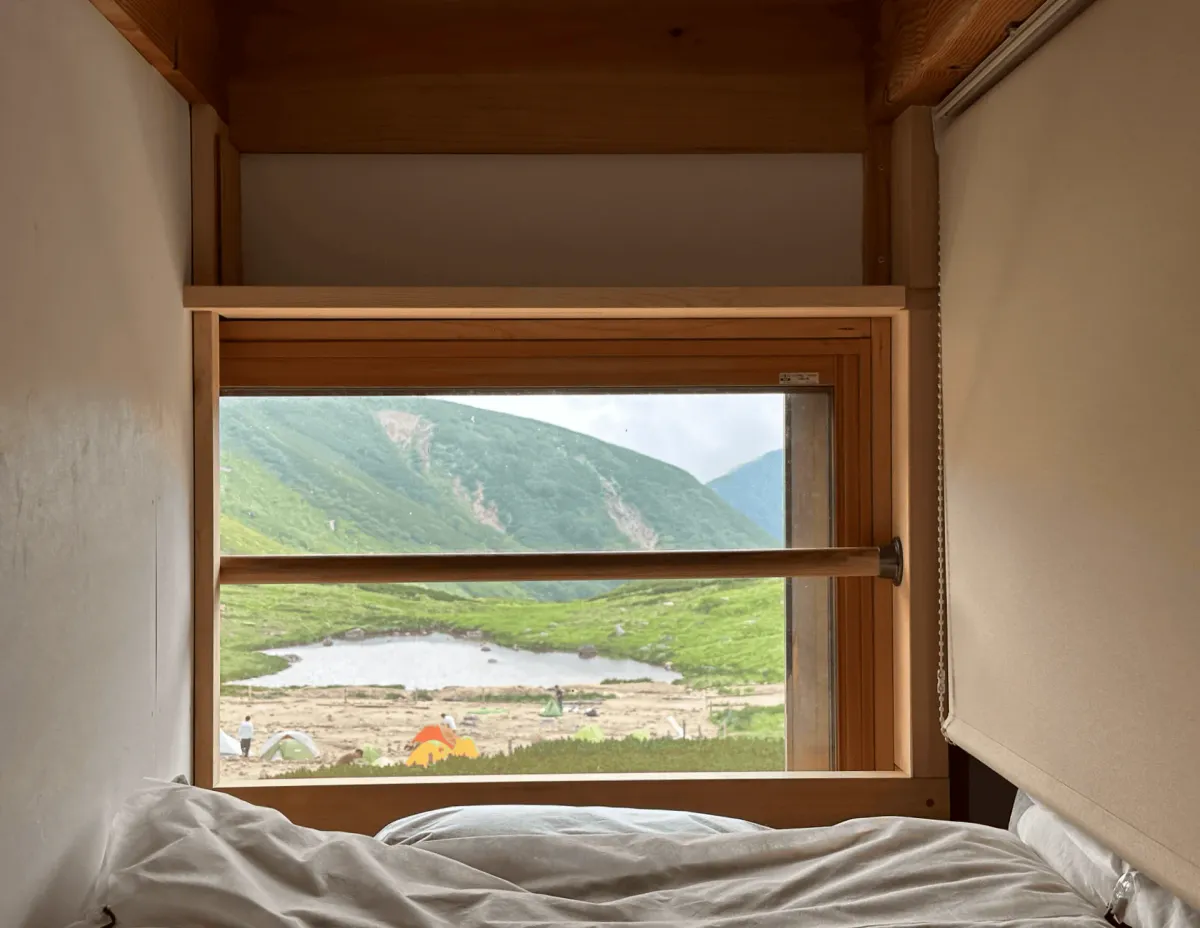
I recently completed my sixth mountain hut stay since I started hiking in Japan, and it was also my first time doing it solo. I’ll admit that the idea of staying in a mountain hut used to intimidate me, but now I quite enjoy it! I find that knowing more about an experience before doing it helps reduce any pre-hike anxiety that I get, so here’s a little bit of an (over-detailed) guide to staying at a Japanese mountain hut. I hope it’s helpful for anyone who’s curious about staying at one - whether you’re completely new to the idea or have done hut stays overseas and want to know what to expect in Japan.
Finding and booking your hut stay
So the first step in staying at a hut is picking a hut. If you had a specific mountain in mind, hiking apps like YAMAP will list courses and you should be able to pick out the hut based on where the map marker is for the end of a day’s hike. If you wanted to see the hikes I’ve done with a hut stay, I have six up on my blog as of writing this post:

Mt Jonen

Mt Washiba and Mt Suisho

Mt Kurobegoro and Mt Yari

Mt Hiuchi and Mt Myoko

Mt Kita and Mt Aino

Mt Senjo and Mt Kaikoma
Mountain huts generally have a website, and if you’re lucky, also have online booking services which make things smooth without needing any Japanese ability (as long as you can use something to translate the webpage). Some mountain huts still do only accept bookings via phone calls though, in which case you may need to find a service that can handle the booking on your behalf if you can’t speak Japanese.
If you want to do a hike on a weekend or public holiday, you’ll want to book as early as possible since these huts can book out. If the hut opens its bookings 2 months in advance, you’ll want to be booking on the day it opens, especially for the more popular huts. If you miss out on a booking, you can try your luck and refresh every day and hope for a spot to open up, as they often do.
Payment will be done either online via the booking service you used, or it will be cash paid on the day. If it’s cash, make sure to bring enough spare cash! There is probably not going to be the option to use electronic money or credit cards in the mountains.
Costs vary from hut to hut, but you’ll be looking in the range of 10,000 yen for a night’s stay, and up to 14,000 yen if you include meals.
Arriving at the hut and checking in

On the day of your hike, I would recommend aiming to arrive at the hut by 3pm. Even though the sun can set a fair bit later than this in Japanese summers, culturally 3 - 4pm is kind of the rough time that everyone is expected to finish hiking for the day, and it will be what the huts recommend you to arrive by. So by setting yourself a 3pm deadline, this can give you an hour’s buffer if you end up needing the extra time and end up arriving at 4pm.

Of course it’s not the end of the world if you arrive at 5pm - usually you see a group of latecomers straggle in around this time - but in that case a courtesy phone call to the hut to let them know of your late arrival helps them not have to worry.
Once you arrive at the hut, you’ll pay if you haven’t already, and also fill out a check-in form. This is going to be in Japanese (maybe with some amount of translations), and what you’ll need handy is some personal details - name, age, phone number and address, and also whether you want the dinner/breakfast options. And also what your hiking plans are for the next day (which mountain or trailhead you are headed to), so it would be good to have those noted down somewhere as well. Don’t fret if you can’t write Japanese! I would just write stuff in all-caps English letters to make it a bit easier to read (definitely don’t do cursive).

Getting a tour of your hut

Usually the check-in desk is accessible without taking your shoes off, but after that, the first thing you’ll need to do is to remember to remove your shoes - huts in Japan are a shoe-free zone. You’ll usually place your shoes at the entrance, or outside of your room if they have a dedicated spot for shoes. You can keep your socks on, and they usually provide slippers for you to walk around in. If the hut staff are not too busy, they should give you a quick tour of the hut, including some (or all) of the following:
- Toilets (there is a different set of slippers specifically for toilets, so make sure to swap into them). Toilets will have toilet paper, but make sure to throw it into the separate bin.
- A tatami’d area for general lounging
- A set of sinks for brushing your teeth (sometimes separate to the toilet area to prevent congestion)
- A tap with drinkable water (most taps won’t be for drinking water, and in some places, there is no free drinking water available. Don’t assume tap = drinking water!)
- A drying room - if you have wet clothes, you should hang them here and not by where you’re sleeping
- Power outlets to charge your phone: sometimes there might be a small powerboard where you can charge your phone, sometimes for a small fee
- A dining area for dinner and breakfast (more on that later)
A hut’s sleeping set up
Some huts let you book private rooms for an extra fee (which can be good if you’re coming as a couple or a group) but let’s assume you are staying in the main sleeping area.

Sleeping setups vary a little from hut-to-hut, but one common denominator across all of them will be that you are sleeping on a futon. This comes with a pillow, which will be a little bit different to the sort of pillow you get in a hotel as it is firmer and filled with beads of some sort. The duvet will be quite thick, so it should be sufficient to keep you warm even in the shoulder (non-summer) months.
The futon is most likely not washed (although I’ve never experienced it feeling super dirty) so in some places they come with a little disposable mesh cover over the pillow and the top bit of the duvet for hygiene. If this icks you out a bit, you could bring your own pillow case and sleeping bag liner. Some places may ask you to bring the sleeping bag liner specifically. When you check-in, you will be assigned a futon, which will probably be folded up in a corner. You’re free to leave it folded up and use it as a sort of backrest, or immediately unfold it and curl up for a quick nap.

In terms of layout, every hut does things a little differently. They might split out the sleeping areas into smaller rooms (oftentimes with two levels), or have one big sleeping room. You might have your neighbour directly next to you (with a plastic divider near your head for a tiny bit of personal space), or you may get a bit more privacy with a curtain or thin wall dividing off certain sections. If you are a woman they will generally put all the women together in one section as well.

Dinner at mountain huts
If you pay extra, you can have a nice hot dinner at the mountain hut. I always go for this option! Mealtime is generally split into 2 time slots, and when you check-in you are assigned a time slot. You’ll also be given some sort of paper that acts as your dinner coupon so make sure you hold onto that. Dinnertime is usually between 5:30 and 6:30pm. When it’s your time slot, you line up, and either grab a tray of food as you enter, or all the food will already be laid out on the tables and so you just go in and are guided to a table.
The food is generally some variation of Japanese food, and the portions are pre-determined. But you can usually get unlimited refills of rice and miso soup to fill you up.


Note that everyone gets the same meal - there is no option to amend things based on your dietary requirements (although you could leave things behind on your plate if you didn’t want to eat them). There is always meat or fish of some sort, so if you are vegetarian I would recommend just skipping this and bringing your own dinner.
If you don’t reserve a dinner meal, don’t expect to be able to buy food separately (other than maybe some cup noodles). Some huts do have a lunch service open to anyone dropping by (think ramen, curry and the like) that ends by around 3pm, so if you arrive early enough, you can buy a meal then if you like.
Bedtime and waketime
After dinner you can brush your teeth and just chill until it’s time for bed (I bring a Kindle to pass the time). Everyone has an early start on the mountains, so everyone goes to bed fairly early as well. Also you’ll probably be exhausted and ready to sleep anyway. Sometimes you can control the light switch in your own room, and other times the building will just automatically turn off all the lights around 8pm. It probably doesn’t need to be said - but just in case - once it’s lights out, everyone goes straight to bed so you try and keep conversations to a minimum at that point.
Depending on what mountain you are on, people will be getting up as early as 4am if they have a long day of hiking ahead of them. I would expect that it would be quite hard to enjoy a sleep-in in a mountain hut, unless you’re a really deep sleeper, so I would keep that in mind. You will probably be awoken by the occasional phone alarm, and others around you rustling their backpacks and getting ready for the day ahead.
Similar to dinner, you can enjoy a sit-down breakfast around 5am. Usually I skip this, and opt for a takeaway “bento” breakfast. Sometimes this is just as simple as two large rice balls, while other times it will be more of a proper bento with rice and fish.

Electricity, cell reception, Wi-Fi
Hiking can be a really nice way to switch-off from the outside world but in case you need it:
- Some huts provide Wi-Fi services for a fee
- Some huts might have weak phone signal, but do not count on it. I generally find that on a long hike, there is at least somewhere on the hike where you can get a bar of signal (try the peak, or ridgelines above the trees) so you can keep checking for it if you need it
- As a side note, if you are looking for a phone provider in Japan, do not go with Rakuten as their coverage is not good in the mountains (I go with Docomo’s subsidiary Ahamo, and they are pretty good)
- Some huts provide outlets for charging your phones, either for free or for a fee. You may have to battle for an outlet spot though, and this will stop working after lights-out. I don’t count on this though, and just bring my own spare battery for my phone.
Are huts dirty? Hygiene and “feeling clean”
When I used to only do day hikes, the biggest thing that turned me off from the idea of doing a hut stay was the general ickiness of it all. You are going to be on top of a mountain after a hard day’s hiking, gross and sweaty, surrounded by other gross and sweaty people, in a building that probably isn’t that nice either.
Note: Before I got into hiking, I was very much an indoor person - my favourite thing to do was spend all day inside playing video games. If you grew up camping and hiking and are used to spending nights outdoors, this is probably not something that crosses your mind 😉
Now I’m not sure why I had this misconception of the uncleanliness of a hut, considering how clean Japan is in general - for all the huts I’ve stayed at, the huts themselves have been very clean, and the interiors are quite nice. So I don’t think you will have anything to worry about there.
The toilets are probably the most unavoidable part. Most of Japan has sit-down toilets these days (other than toilets at old train stations or in rural areas) but the chance of you meeting a traditional squat toilet in the mountains is higher, so be prepared for that. Sometimes hut toilets can be ridiculously clean, and even flush. But other times there can be a bit of an unavoidable smell as basically you are doing your business down a long chute to where all the waste sits. If you are used to using dirty toilets at trailheads, or along the trail, I would say the hut toilets are at least a step up from that. But I think for a beginner hiker used to the general cleanliness of Japan, it may be a bit of a shock at first.
In terms of personal space, if you can, I would recommend aiming to stay on a weekday when the hut isn’t at max capacity, so then you should hopefully be able to have a bit more room and are spread out from the other people spending the night. Women are generally at least a little bit separated from the men in the sleeping area, so if you’re a girl I wouldn’t be concerned on that point either.
On the personal hygiene front, mountain huts generally don’t have showers! Maybe an obvious fact to some, but just in case you were wondering. There are rare exceptions, so if you were really concerned about this, maybe you could research to try and find one that does have a shower or onsen. To clean up after a day’s hiking, I usually bring a couple of makeup remover / face cleaner wipes in a ziplock bag (I don’t wear makeup, but I figure if they can remove makeup they must be on the stronger side).
Just using the wipes leaves me feeling a bit sticky, so after wiping down my face, I’ll splash my face with water as well (so bringing along a tiny little towel can come in handy here). I’ll also wipe down where I can - chest, underarms, legs (which can get kinda sticky with dried sweat).
The other most important thing is a fresh t-shirt! Having a separate shirt to sleep in goes a long way to remove that sweaty, sticky feeling. I’ll swap out underwear, but usually I’ll wear the same long pants I wore on the hike and that feels OK enough.
Cleaning my face and putting on some fresh clothes actually gives me enough of a “clean” feeling to where I feel comfortable, but I think this is just something you need to experience at least once for yourself to figure out how you find it.
Why stay in a hut?
Although some people love the idea of spending a night camping or being in the mountains, I’ll admit I still rather like the comfort of my own bed (and a shower) at the end of a day’s hike. However as I started to hike my way through Japan’s Hundred Famous Mountains, I realised that certain peaks were inaccessible as a day hike and required a night (or two’s) stay along the trail. And as I started to venture out of my day-hiking comfort zone and do these overnight hikes, I found that actually, staying in a hut isn’t so bad!

I would say the main pro of using a mountain hut (for me) is that it lets you experience mountain peaks and views you wouldn’t be able to otherwise:
- You get to enjoy a peak that would be otherwise inaccessible as a day hike
- You can enjoy sunsets and sunrises (if you’re awake)
- Spreading out your hike over two days increases your chances of having a sunny day for at least one of them

Most mountain huts also come with a campsite right next to it, so you might want to interrupt me here and tell me that this pro applies to tent-users as well - which it does! But that brings me to my second point:
Hut stays mean lugging less gear up the mountain (compared to tents). I have a lot of respect for people who can do multi-day hikes with a tent, and I have done it a couple of times, but sometimes I worry a bit whether I have enough physical stamina to do a hard day’s hiking with a tent and sleeping gear as well. And so knowing that I have a hut stay booked gives me one less thing to worry about. Huts also provide dinner and breakfast for an extra fee, but if you are camping, you have to mostly bring all of your own food (and cooking gear) as well.
Another pro for a hut stay is that you don’t have to worry about poor weather conditions overnight. Luckily I haven’t had to experience it myself, but if you had a windy night in a tent, you can imagine it can get a little nerve-wracking with those loud noises that keep you up all night. And one time I did a hike with a tent at the end of October, and it turned out to be a little too cold (my feet in particular get cold very easily) and I didn’t end up getting a very good night’s sleep. Of course from those tent stays you do gain experience as well (I know now to bring thick down socks for extra comfort on cold nights).
Although I would say that you shouldn’t have anything to fear about camping at a hut’s campsite in Japan, maybe there is something to be said for the reassurance that being within four walls can bring as well, especially if you are hiking solo.
Reasons why you might not want to stay in a hut
The biggest con of hut stays in Japan is the cost. Prices vary on where you go, but you’ll be looking in the range of 10,000 yen for a one night’s stay at a hut, which can rise to 12,000 - 14,000 yen if you want a hot meal or two included in that as well. This is in comparison to a night’s stay with your tent, which is only in the range of 1,000 - 2,000 yen. Weather can vary quite considerably on the mountain, but hut bookings generally have a cancellation fee that kicks in 3 days before your booking, so you’ll either have to cough up that money or brave the poorer weather if luck is not in your favour.
This relates to my second con of less flexibility. Campsites generally don’t require a booking - you may just have to be mindful of arriving early enough to snag a good spot - but huts will often book out on the weekends (and sometimes even on Friday / Mondays too) so you will have to get in early with your booking, or settle for booking on a less popular weekday. With a tent stay, you can make last-minute plans, and change your plans to a different mountain to get better weather as well.
The third con is a bit variable (and maybe you’d end up with the similar issues when staying in a tent) but you can end up with a lack of personal space if your neighbours are sleeping quite close to you, and the snoring can get quite loud as well. If you book your stay on a night that isn’t fully booked, then hopefully everyone will be a bit more spread out and you can get some more room to yourself. Maybe bring some ear plugs.
A mountain hut packing list
To round off this post, here are some of the things I think are worth bringing:
- Spare cash (especially if you are paying on the day)
- Personal hygiene: Face/wet wipes, deodorant, toothbrush/paste, moisturiser, a small towel
- A spare shirt and underwear to sleep in, spare socks just in case.
- (Optionally) a sleeping bag liner and pillow case to sleep with
- A battery pack for your phone
- A jacket. Even if you are hiking in summer, eating dinner or sleeping at 2000m elevation can get a little chilly. I have a cheap down jacket from Uniqlo that compresses into a small bag so I always bring that while hiking
Read more
Support me
📸 Thanks for reading! If you'd like to read more posts like this one, you can follow me on Instagram to stay up to date on my hiking adventures.
If you found this post useful, you can show your support by buying me a coffee - I write this blog for fun, but coffee is always appreciated! ☕
Recent posts
 hikes
hikesMt Nokogiri: a hike to Chiba's stone quarry
18 Mar hikes
hikesMt Miura-fuji and the Miura Kaigan Cherry Blossom Festival
9 Mar hikes
hikesAkabokko: hiking in Ome
16 Feb
Comments
Leave a comment