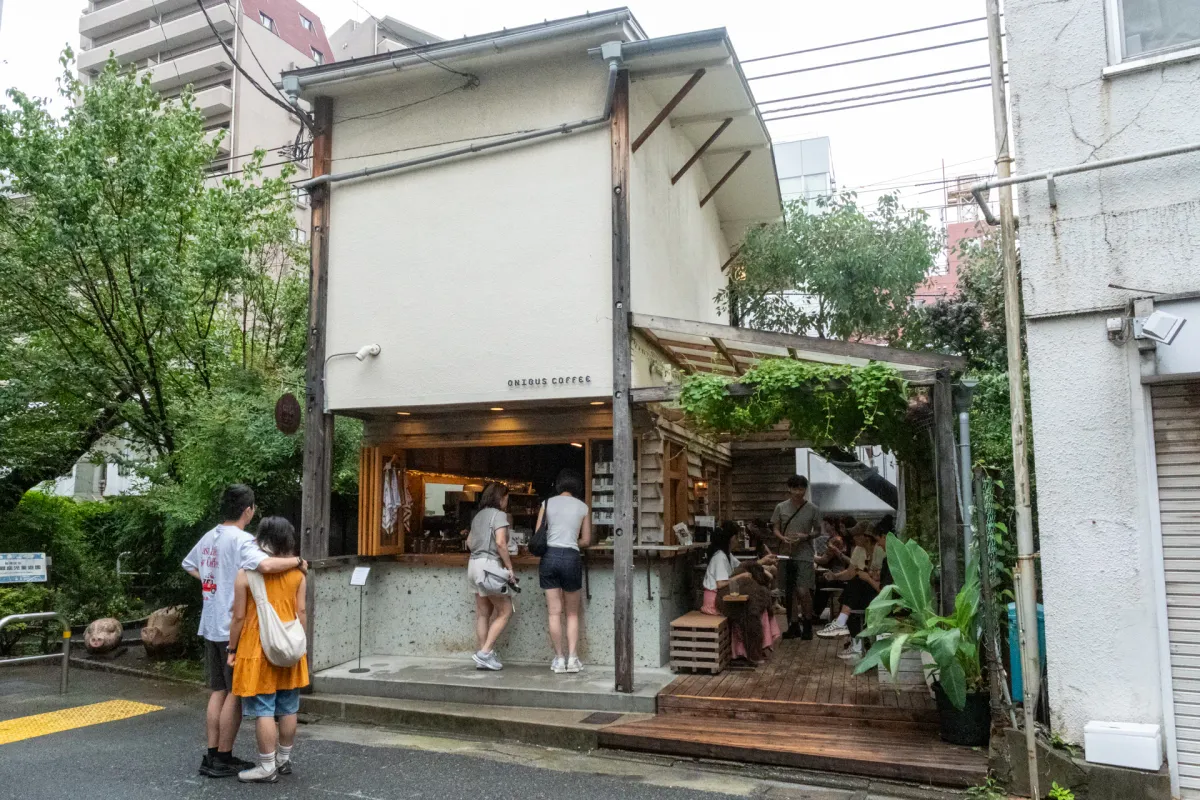
Onibus Coffee is a coffee shop in the residential neighbourhood of Nakameguro. They specialise in light roasted beans, and offer both pourover and milk-based coffee options. Nakameguro is a rather trendy place to live, home to the Meguro river - popular for its cherry blossoms in spring - and also for Japan’s one and only Starbucks Reserve Roastery. It’s slightly upscale vibe means there’s quite a few good coffee shops in the area.

If you’re curious where the name “Onibus” comes from, they took it from the Portuguese word for “bus”, as they wanted to build a place that is fundamental to a city like public transport is.
And they’ve done a pretty good job of building it, because it did really give off that “your local cafe” vibe you might be familiar with if you lived in a coffee-loving city like Sydney (where I grew up).

Since the cafe is right next to the train tracks, if you head up to the second floor you can get a window seat with a rather nice view of the many trains pulling out of Nakameguro station. Of course, this is prime seating so when we first headed up there there was a couple already enjoying the view.

For a change of pace, I decided to get their latte (715 yen, plus an extra 88 yen surcharge for soy milk).

Since I’ve been in a pourover phase lately I’ve almost forgotten what a good latte tastes like, I think this one was pretty good! A very smooth taste.
My husband got a pourover with their Honduras bean (880 yen).

They sell 9 types of beans, and you can choose from any of them for the pourover - the prices range from 880 yen for a cup on the cheap end (Honduras, Kenya) up to 1430 yen for their Peru Geisha bean. Overall fairly reasonable prices - nothing super out there. I get the feeling they are going more for reliable beans rather than something wacky and super-expensive.
Once the couple at the window seats left, we quickly took the opportunity to snag their seats.

The owner came upstairs to let us know that he was giving out free samples of their Kenyan bean (iced) so we took him up on his offer.

I would say personally I enjoyed the Kenyan bean more. It tasted a bit sweeter, and didn’t have any hints of tomato like I keep getting whenever I take Kenyan beans home to do a pourover. (For some reason, I am yet to get the tomato taste in a store so I’m not sure what’s up with that).

My husband got rather interested in the porcelain mugs the coffee was served in, and it looks to be a branded one that you can buy.

Buying some beans
The coffee tasted pretty good, so once we headed downstairs, we decided to pick up some beans.

It was quite hard to choose a bean, but we ended up going with 100g of the Honduras (1539 yen) since my husband was a fan of it, and also 100g of their Brazil bean (1782 yen). I hadn’t bought a Brazilian bean before so I was quite keen to try it out - and it was also made with an anaerobic process which I tend to be a fan of.
All their beans are available on their website if you wanted to get a sense of the prices, but the Honduras bean was the cheapest, and it went up to 2808 yen for 100g on the high end for their Peru Geisha. They also stock a couple of blend beans which are a bit cheaper - 1080 yen for 100g.

The packaging is rather cute - they have a different pattern for each country of bean that they stock. The store did give off a small, independent vibe, but they do actually have 5 stores in Japan, plus another 3 overseas, and over 100k followers on Instagram so they are by no means a small company.
After buying 500g worth of beans, you also get a free cup of coffee.

Although it is like a local coffee shop, I will say that 80% of the customers were foreign like me, which tends to kind of be a theme with these more upscale coffee places we’ve visited lately. I think to begin with, the idea of a local coffee shop where you grab a espresso/milk-based coffee to-go is more of a Western thing culturally. So maybe these types of stores tend to draw people from overseas (whether they now live here or are just visiting) who want their habitual fix of good coffee in the morning.
While Onibus had been on my radar (ish) for a while, what actually prompted me to visit was that recently I bought a cute pixel art print of coffee gear to hang on my wall. And as I looked closely at all the elements to try and figure out if any were Japanese, I saw that they had some beans from Onibus on there.

Onibus beans: recommended pourover method
When we bought the beans, we also got a free postcard, plus a brochure with photos explaining their coffee bean sourcing process. It seems they put rather a lot of thought into the types of places they buy their beans from and to be as sustainable and ethical as possible, which is commendable.

They provide 3 separate sets of instructions depending on whether you want to make hot or iced pourover, or a cold brew.

For the hot pourover the instructions are:
- 13g of beans, 225g of water (1:17.3 ratio)
- A temperature of 92℃
- 40g bloom which you’re supposed to stir with a spoon
- Then spiral pours of 80g, 60g, 45g in 30 second increments
It was my first time seeing the stir with a spoon recommendation, which is kind of a hassle and I’m not sure it was worth it. Also I’ve been seeing 200g water recommendations lately, so it was interesting to see they go as high as 225g.
Onibus beans: the verdict
The beans come with a roasted date on the back of it. The pamphlets we received didn’t really note anything about the recommended wait times, but we ended up opening the Honduras one within 2 weeks since we ran out of beans anyway.
My initial impression with the Honduras could go in two directions. On one hand, it was very, very smooth and didn’t have any sort of acidity. Great for a beginner-friendly light roast bean if you are wanting a good cup of coffee. On the other hand I felt a bit underwhelmed because it didn’t really stand out in any noticeable way. We had some Ethiopian beans leftover from Leaves to compare it to, which had more of a floral scent and overall tasted more interesting.
I also did feel that it did taste a bit better at the store, so maybe it’s a technique thing. My husband’s deadpan reply - “Probably the mug. We need the mug.” Which of course, considering it’s 5,800 yen we are not going to buy it (nice mug, though).
I’m quite delayed in getting this post up (we visited the store over 3 weeks ago) because we decided to wait out the Brazil beans until they had passed 3 weeks from the roast date. The Brazil bean was made with anaerobic processing, which I tend to be more of a fan of (more of a funky taste) and I did enjoy the Brazil bean a tiny bit more - it had a sweet scent to it as well - although the taste still felt quite subtle/smooth. We started off on 15 clicks on my Timemore C2 grinder, but it drained quite quickly so after that I stuck with 12 clicks.
Because of the subtle taste, we also just stuck with our usual 200g water / 13g beans ratio instead of their recommended 225g.
I really do think maybe the Kenya bean is the winner here, so I might have to go back and buy it sometime.
Ice hand drip vs Japanese-style cold pourover
So I’d heard recently about Japanese-style cold pourover or “flash pourover”, which involves making the pourover and having it drip directly onto cubes of ice that are in your pot to lock in the taste. Interestingly Onibus’s recommended “ice hand drip” method just has you making your pourover coffee like normal (but at a bit of a higher concentration) and then adding the ice cubes in afterwards.
For curiosity’s sake we did give both both methods a try (I tried this recipe). And I did find I preferred Onibus’s method, actually. I think the main reason would be the ratio of coffee to ice cubes was in Onibus’s favour.

Hi, I'm Emma!
I'm a long-time lover of coffee - back in Sydney my go-to drink was always a soy cappucino. After I moved to Tokyo 4 years ago, I discovered the wonders of pour-over coffee and now I'm always on the lookout for new coffee beans to try. So far I've checked out 31 coffee shops and roasters here in Japan.
If you found this post useful, you can also show your support by buying me a coffee ☕

Comments
Hi Emma! Great post! I love finding these on bubbles.town lol.
The tomato notes you pick up in Kenyan coffees are quite common for a lot of coffee drinkers — different people experience that taste in different ways because our brains are weird & funky like that — but most often you'll hear people refer to it as tomato. Another example of this odd brain stuff is the flavour compounds for cherry and almond are very very similar, so if you give one cup of coffee to two different people it's totally reasonable that one of them would say "tastes of cherry!" and the other would say "no, it tastes of almond". Like the black/blue dress debate on the internet a while back lol.
But the reason you may be getting that flavour at home, and not at a cafe where you bought the beans could be (and I'm only guessing here but,) because of the water you use to brew with, or the grinder/grind-size, or recipe.
Experiencing a tomato flavour in coffee is typically pointing towards the coffee being "under-extracted", so you could try and increase your extraction somewhat to see if those tomato flavours disappear. To increase your extraction you could try increasing brewing temperature, you could grind finer than you normally would, or you could increase the amount of water you pour through the beans (although if you do this by too much, you'll end up with a weak cup overall, also not nice!)
Hope you're well!
Si
Oh hey Si, thank you so much for your detailed comment! There is so much to learn about coffee, but I will try some of your tips next time I get a tomatoey batch of beans. Quite coincidentally when I was googling how to make the Japanese-style cold pourover I saw one of the top results was from Kurasu. Also I think I came across your Kyoto sound walks page just recently too, seems very interesting :)
Leave a comment