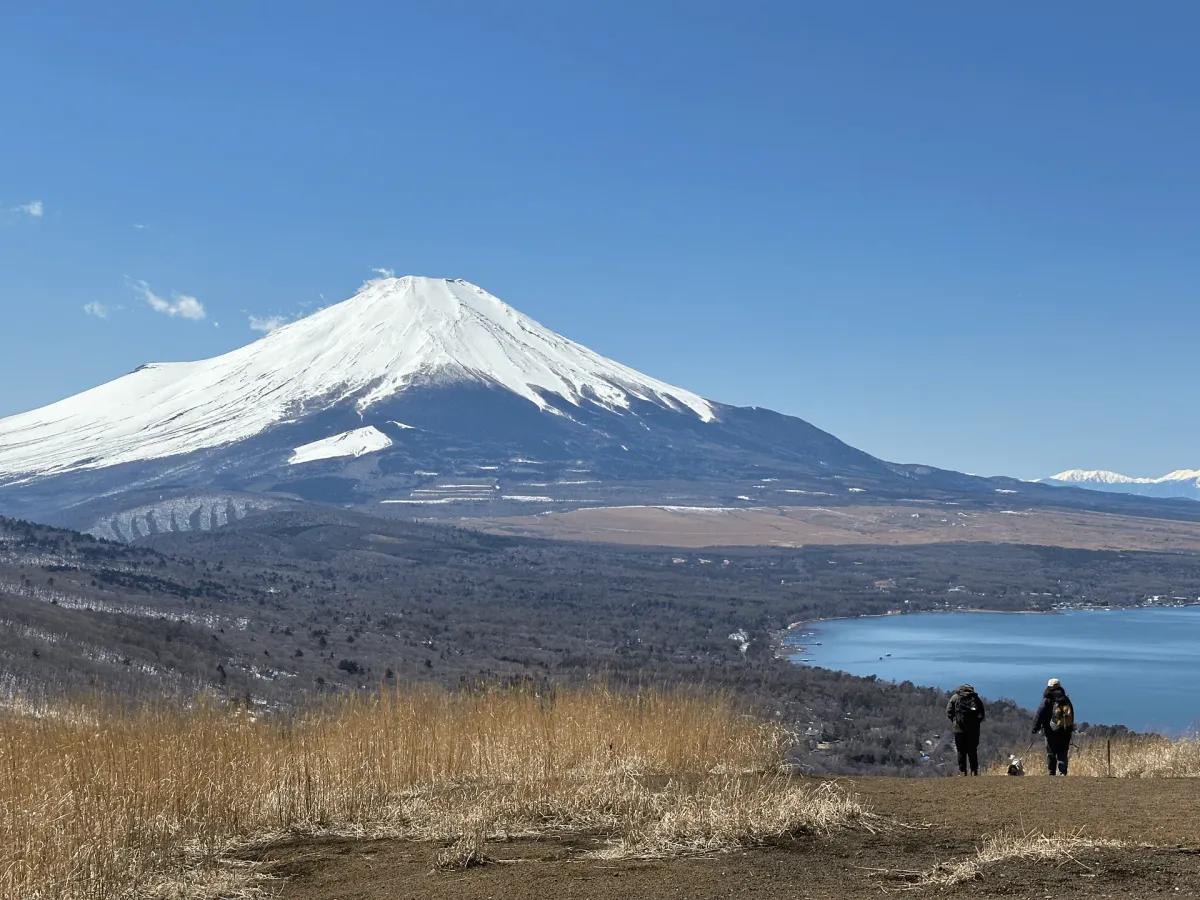
Over the past 3 years of hiking in Japan, I’ve had the pleasure of spotting Mt Fuji on numerous occasions (as well as climbing it too). I’ve compiled a list with some of my favourite hikes to get a view of Mt Fuji from in both the Fuji Five Lakes area, as well some hikes that are slightly further away, but still provide some great views, such as the Tanzawa mountains and Mt Daibosatsu.
I find that setting out on a hike with the expectations of meeting Mt Fuji can be a bit of a gamble. Sometimes that promise of a Fuji view ends up with a feeling of disappointment when the peak is obscured by some pesky clouds. Other times, I wasn’t planning on seeing Mt Fuji at all, and it’s such an unexpected yet lovely surprise when I turn a corner or get above the treeline, and there it is. The best feeling is when Fuji is nowhere to be seen, but then the clouds miraculously part - giving you the time to snap some pictures before it disappears again.
When to see Mt Fuji
If you are planning a hike with the hopes of seeing Mt Fuji, I would recommend aiming for the colder months (November - April). There’s two reasons for this:
- Your chances of seeing Mt Fuji are higher when it’s cold. You’ll have a more than 80% chance of seeing Mt Fuji in February, while you’ll only have about a 30% chance in September (source).
- A lot of the mountains on this list are lower in elevation. Japanese summers are very hot, and in the summer months you generally want to get up as high in elevation as you can (up to 3000m) to escape the heat. Although Mt Fuji itself is quite tall (3776m), most of the mountains on this list are much lower in elevation (around the 1500m mark). Depending on where you go, there can be plenty of bugs about too. (In contrast, winter is very bug-free). After one traumatic experience in July where I got hit by spiderwebs on the trail time and time again, I’m done with hiking low-elevation mountains in summer!
Japan has a lot of amazing high-elevation mountains to hike in summer, so it can be quite sad to have to say goodbye to them each year as it gets colder, but being able to see Mt Fuji from these low-elevation hikes in the winter months is a nice silver lining.
Hiking in the Fuji Five Lakes Area
There are five main lakes around Mt Fuji, and the hiking trails around here will let you get the closest view of Mt Fuji.
Mt Mitsutoge (Lake Kawaguchiko)

Mt Mitsutoge
Lake Kawaguchiko is most accessible of the Fuji Five Lakes, and so the nearby Mt Mitsutoge is at the top of my list. From Kawaguchiko station, it’s a 25 minute bus ride to the Mitsutoge trail head (三ッ峠登山口) bus stop. From here, you can do a 12km, 5.5 hour course up to the peak and then back to Kawaguchiko station.
For those wanting an even longer trail, you can also do 15km station-to-station hike starting at Mitsutoge station and ending at Kawaguchiko station. I had the opportunity to do this in late March, and got to pass a lot of beautifully flowering sakura trees that I would have otherwise missed, so it was quite a nice hike!
Mt Ishiwari (Lake Yamanakako)

Mt Ishiwari
Lake Yamanako is the largest of the Fuji Five Lakes, and is also the closest lake to Mt Fuji. The nearby Mt Ishiwari lets you get a great view of both the lake and Mt Fuji in the same shot. Although there’s no train station nearby, conveniently there is the option to get a highway bus directly from Shinjuku station to the trailhead, where you can do a 5 hour hiking trail up to the peak, and then back down to the lake.
Mt Ryugatake (Lake Motosuko)

Mt Ryugatake
Mt Ryugatake is next to Lake Motosuko, the third-largest (but deepest) of the Fuji Five Lakes. Its trailhead is at the Lake Motosuko bus stop (本栖湖バス停), which is a 50 minute ride from Kawaguchiko station. From here, you have a beginner-friendly 6km loop course that should take you 4 hours. I also have to make a shoutout to Mt Amagatake and Mt Kenashi, which neighbour Mt Ryugatake on either side. If you were looking for a longer hike, there’s multiple hiking options here, including a 14km, 9.5 hour course that passes all three.
Lake Motosuko also has a rather large campground, so if you’re interested in camping, you can spend the night here before setting out for your hike the next morning.
Mt Odake and Mt Onigatake (Lake Saiko)

Mt Odake and Mt Onigatake
Mt Odake and Mt Onigatake are two peaks close to Lake Saiko that can be done as a loop hike. Its trailhead is at “Iyashi no Sato”, which is a tourist spot in its own right, and can be accessed by a 40min bus from Kawaguchiko station. This hike felt like a bit of a hidden gem - there are some spots on a exposed ridgeline where you can get some really great views of Mt Fuji. I would class it in the “hard” category only since the hike is over 6 hours, and there are small sections where you have to navigate a steep rock with a rope.
Mt Sanpobun (Lake Shojiko)

Mt Sanpobun
Lake Shojiko is the smallest of the Fuji Five Lakes, and is also the least-developed. So I found Mt Sanpobun to be quite nice if you want to get away from the crowded Lake Kawaguchiko! You can get Fuji views from both the trailhead and the Panorama-dai partly up the trail. I quite like how from Lake Shojiko you can see this cute little mound in front of Mt Fuji. The course is a 8.5km loop, and takes 5 hours.
Myojinyama (Lake Yamanakako)

Myojinyama
You’ll notice so far I have listed one mountain for each of the five lakes, but I couldn’t help but mention Myojinyama on here as well. I wouldn’t recommend it as a proper hike, as it’s quite a short 1.6km trail from the trailhead to the summit, but it came with one of my favourite views ever of Mt Fuji. The trailhead is best accessed by a car, as the public transport options are quite limited.
Hakone area: Mt Kintoki

Mt Kintoki
Moving out of the Fuji Five Lakes Area, another beginner-friendly mountain that is still quite close to Mt Fuji is Hakone’s Mt Kintoki. Accessible via a highway bus from Shinjuku to the Kintoki shrine trailhead (金時神社入口) the peak of Mt Kintoki has a rather large axe you can take a photo together with.
As well as the 3 hour course from the trailhead, there’s also the option to keep hiking past Mt Kintoki to the neighbouring Mt Myojingatake (明神ヶ岳) for a total 6.5hr, 11.5km course.
Hiking in the Tanzawa mountains (Kanagawa)
A little further away from Mt Fuji, the Tanzawa mountain range is my next favourite place to see Mt Fuji. I actually find that since you are on the eastern side of Mt Fuji you can get some really nice photos without any glare thanks to the sun being at your back.
Mt Oyama

Mt Oyama
Mt Oyama is the most beginner-friendly mountain in the Tanzawa mountain range, with cable car access making it doable as a 3 - 4 hour hike. Fom Tokyo, it’s a 75-minute train ride to Isehara station, then a 30-minute bus to the Oyama Cable bus stop. You’ll be able to spot Mt Fuji from near the top of the trail.
Mt Tonodake

Mt Tonodake
Mt Tonodake and the neighbouring Mt Tanzawa are popular mountains for locals living in the Kanagawa area. To reach the Okura trailhead, you’ll be looking at a 2-hour trip from Tokyo, taking a local bus via Shibusawa station. At 8 hours round trip the trail is long, but well-maintained, and so can make for a great training mountain if you’re looking to get some hikes in in the colder months. Of course, not to mention the amazing view of Mt Fuji which you’ll start to spot from partway up the trail.
Mt Nabewari

Mt Nabewari
Another Tanzawa mountain that can be hiked from the Okura trailhead is Mt Nabewari. Its particularly popular for the nabeyaki udon sold at its summit. If you’ve already climbed Mt Tonodake or Mt Tanzawa and are looking for another Tanzawa mountain to check off of your list, Mt Nabewari is another great option.
Mt Daibosatsu (Yamanashi)

Mt Daibosatsu
At 2056m, Mt Daibosatsu is the highest in elevation of the mountains on this list, and is quite a far bit away from Mt Fuji compared to the Five Lakes region, but I think seeing it together with the Kamihikawa dam makes for a pretty cool shot. The standard loop course is only 3 - 4 hours, so this is another beginner-friendly option with some great views.
Mt Daibosatsu is particularly popular in autumn, when you can enjoy the colours of the autumn leaves (or “koyo”). It’s a 3-hour trip from Tokyo, with a shuttle bus departing from Kai-Yamato station.
Seeing Mt Fuji from Tokyo
You can see Mt Fuji even from Tokyo on a clear day, so two of the mountains I’ve previously mentioned in my Tokyo day hikes post are also candidates for a Fuji view, if you don’t want to get too far from Tokyo.
Mt Takao and Mt Jinba

Mt Takao
With only an elevation of 599m, your view of Mt Fuji from Mt Takao will be slightly obscured by the mountains in front of it, but it is possible to see it on a clear day! This is probably the closest mountain to Tokyo that you can climb and still see Mt Fuji from.
Access to Mt Takao is via train on the Keio line to Takaosanguchi (高尾山口) station, and takes under an hour from Shinjuku station. There’s a cablecar and chair lift, so you can do the hike in under an hour. I would say Mt Takao is great if you are looking to spend a bit of time in nature and check out its temple, without doing too much of a strenuous hike.

Mt Jinba
Directly next to Mt Takao is the peak of Mt Jinba, which comes with a rather suspicious-looking horse statue. From here you can also spot Mt Fuji, and your view should be a little bit better than from Mt Takao as you are another 200m up in elevation. Mt Jinba’s hiking course will take you 7 hours, and is a 15km course that ends at Mt Takao.
If you’re looking to go to Mt Jinba, you’ll need to get the train to Takao (高尾) station - note this is a different train station to where you’d get off for Mt Takao - and then a 30 minute bus to Jinba-kogen (陣馬高原).
Mt Mitake and Mt Odake

Mt Mitake and Mt Odake
Mt Mitake has a number of hiking courses, but if you hike out to the neighbouring Mt Odake (a 9km hike) you’ll get a chance to see Mt Fuji at its summit. Public transport access is 2 hours by train from Tokyo to Mitake station on the JR Chuo line, and then a 10 minute bus trip from the station to the Mitake cablecar.
Mt Fuji’s visibility forecast
If you want to increase your odds of seeing Mt Fuji, as I mentioned at the start of the post, you’ll want to go in the colder months. There is also this “When to See Mt. Fuji?” website which provides a visibility forecast, so you can try and time your chances.
According to this source, your odds of seeing Mt Fuji are higher in the early morning, which I have found to be true - sometimes I’ll be on the train or driving to the trailhead, and spot Mt Fuji along the way, but then it completely disappears by the time I start my hike. If you spot Mt Fuji, I would recommend getting a photo of it while you can!
How far away can you see Mt Fuji?
As a final fun fact, did you know you can see Mt Fuji from far away as Gunma? I have spotted it from the peak of Mt Shibutsu - which is 175km away. Apparently you can see it from 323km away in Wakayama too which is pretty crazy.

Read more
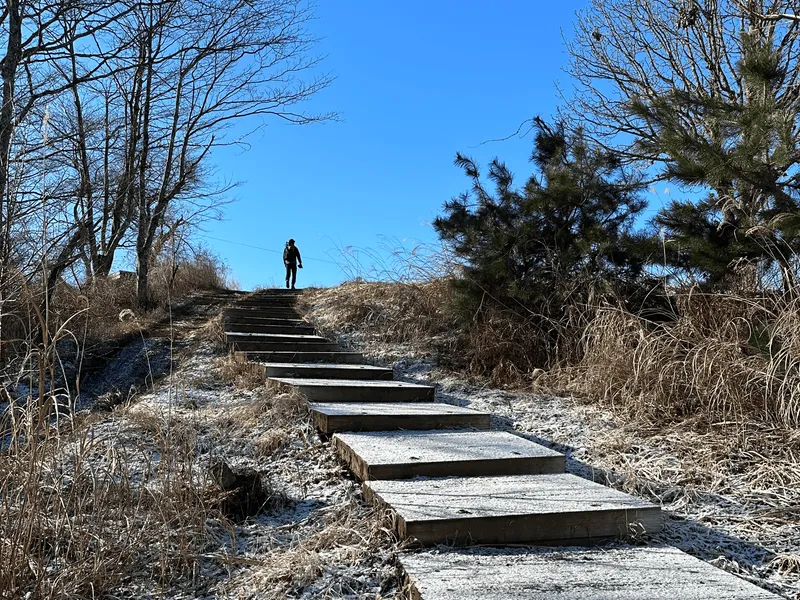
Support me
📸 Thanks for reading! If you'd like to read more posts like this one, you can follow me on Instagram to stay up to date on my hiking adventures.
If you found this post useful, you can show your support by buying me a coffee - I write this blog for fun, but coffee is always appreciated! ☕
Recent posts
 hikes
hikesMt Nokogiri: a hike to Chiba's stone quarry
18 Mar hikes
hikesMt Miura-fuji and the Miura Kaigan Cherry Blossom Festival
9 Mar hikes
hikesAkabokko: hiking in Ome
16 Feb
Comments
Leave a comment