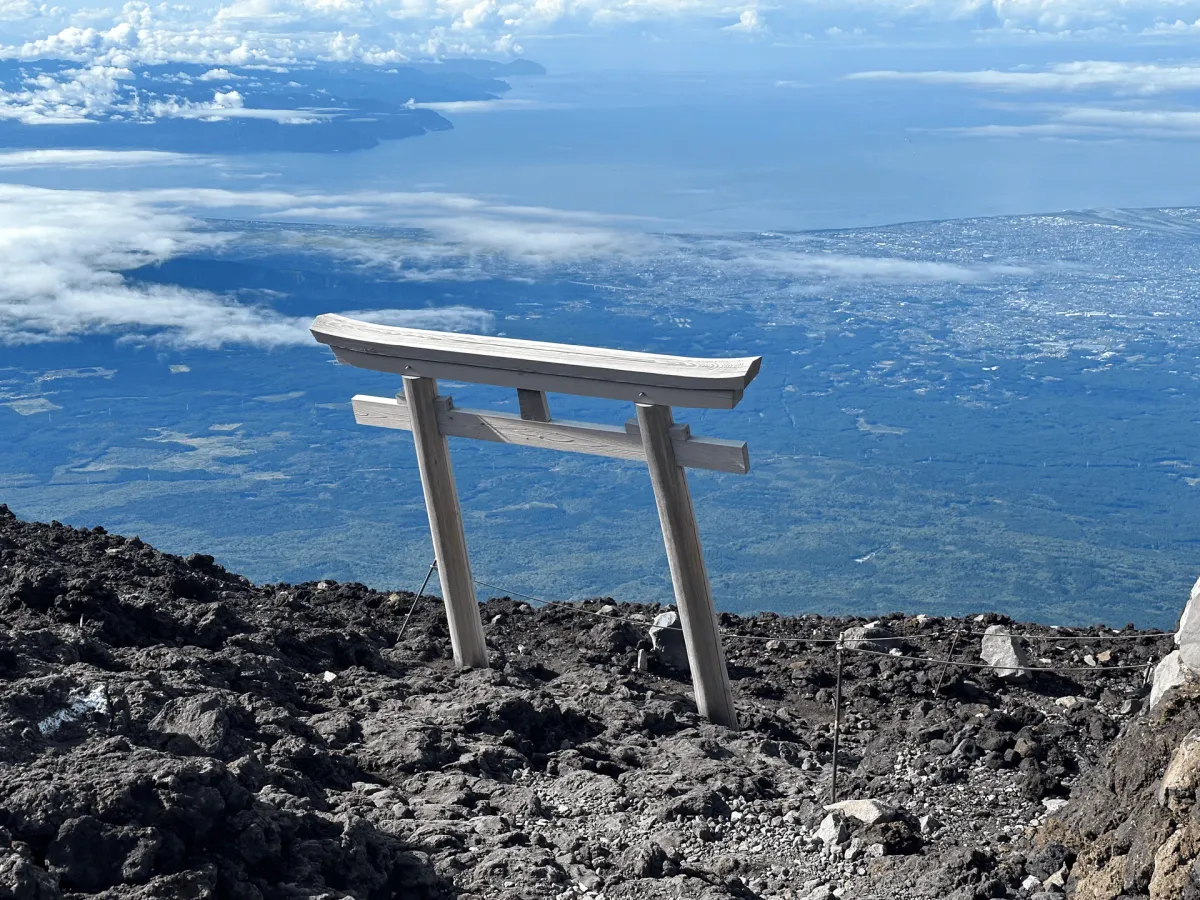
- Elevation3776m
- When to climbJuly - August
- If you're taking the most popular Yoshida trail, expect to hike 15km over 10.5 hours. Can be broken up into 2 days.
Mountain stats
Access to the trailhead via local bus from Kawaguchiko station, or come via an overnight bus from Shinjuku.
Due to Mt Fuji's popularity, not recommended by car.
Mt Fuji (富士山, fuji-san) is by far Japan’s most iconic mountain. I’ve had the opportunity to see it from a distance many times on different hikes, but each time the sight of it blows me away. Climbing it can be an amazing experience too, if you are prepared for the long 10 hour hike and are lucky with the weather conditions.
The most-recommended way to climb Mt Fuji is with an overnight stay at one of the mountain huts partway up the trail. However I’ve heard it’s not too pleasant of an experience, as you are really tightly squeezed in with the other guests, and you probably won’t get much sleep.
Mt Fuji can also be attempted as a regular day hike - you can spend the night in the nearby town of Kawaguchiko and get one of the earliest buses in the morning to the trailhead. However the course is quite long and you will need to be in good physical condition to be able to finish your hike in one day. Not to mention your risk of altitude sickness is higher if you don’t take enough breaks to acclimatise.
My preferred method of climbing Mt Fuji is instead to get on a late-night bus from Shinjuku station, which drops you off at the Yoshida trailhead at 3:30am. The one downside is you probably won’t get much sleep on the bus, but otherwise it’s technically a “day” hike and you’ll be able to take a more leisurely pace up and down the mountain (which should also help stave off the risk of altitude sickness).
Hiking Mt Fuji: a quick summary
Overnight bus from Shinjuku (departs ~9:45pm, arrives trailhead 3:30am). Or local bus from Kawaguchiko station to the Fuji Subaru Line 5th Station.
- Yoshida trailhardBus10.5 hrs·15 km·↑ 1400m
How hard is it to hike Mt Fuji?
Before jumping into my hike report, I wanted to talk about the difficulty level of climbing Mt Fuji as it’s an alluring peak for many people, including those that might not commonly go hiking.
In short, I would put Mt Fuji at a “hard” difficulty level in the sense that you need the mental fortitude to pull off a 10.5 hour hike in one day. In terms of the actual trail though, it’s not very difficult to walk so it can be climbed by beginners to hiking as long as you have an appropriate fitness level.
If we consider it from a couple of different angles in more detail:
- The trail conditions itself: are not particularly difficult. Some parts of the hike up are switchbacks on a slightly gravelly path. On other parts you may have to slightly clamber up over rock and there are chains available for balance. But it’s not difficult to the point where you are having to hoist yourself up or do any sort of rock-climbing or anything like that.
- The high altitude: with a max elevation of 3776m, Mt Fuji is Japan’s tallest mountain. At higher elevations, you can be affected by altitude sickness, which personally I find can set in around the 3000m mark if you’re not careful. However as long as you pace yourself and drink plenty of water, I think you will be fine, and personally I did not have any problems.
- The length of the hike itself: climbing Mt Fuji involves a 15km climb with 1500m of elevation gain, and is expected to take 10.5 hours. If you have experiencing doing hikes of this length normally, then you will know what to expect. Otherwise this is probably the most unknown variable out of the three as it’s a bit hard to say for sure how “fit” you need to be to pull this one off. If you can, I would recommend preparing for this hike by building up your anaerobic fitness by getting into running/jogging a couple of months before your hike (say like distances of 5 - 10km). Personally maybe at my peak fitness I could run 10km at a 6:30min/km pace at best, if that helps give you any sort of indication - you don’t have to be a super fast runner or anything.
- Whether you need a guide: the climb up Mt Fuji is fairly straightforward, and you should have no trouble finding your way up - plus there will no doubt be plenty of other hikers around. You do not need a guide. However, you will need to make sure you have your logistics and timings planned out, e.g. start at this time, summit by this time, and so on, so if you would like someone else do to that planning for you, then a guide may be helpful.
Starting my hike at the Subaru 5th station (Yoshida trail)
Taking the overnight bus (which I cover in more details below), I arrived at the Subaru 5th station trailhead at 3:30am.
I climbed Mt Fuji back in 2023, back when there were no restrictions. Due to overcrowding on the trails, the Japanese government added some new entry restrictions in 2024, and the trail gate is closed to new hikers from 2pm to 3am (you cannot start your climb during this window). Luckily the overnight bus drops you at the trailhead at 3:30am so this approach is still fully compatible with the 2026 rules. You will need to make a trailhead reservation beforehand and pay ¥4,000 as well.

Since it was still dark on the trail, I started off with a headlamp. I hiked on a weekday at the end of August (the tail-end of the season), so it was pretty quiet, but a handful of people got off the bus with me. So the trailhead wasn’t completely deserted, although quiet enough that I was completely alone for parts of the first hour of the hike.

The trail should be signposted well-enough, but you can also make use of Japan’s GPS hiking app YAMAP if you want the extra certainty you are heading in the right direction.
As you begin climbing, you can spot the lights of the city down below, as well as the little lights coming from other hikers and the mountain huts further up on the trail.


But it quickly starts to get light as the sun prepares to reveal itself, and soon the trail is lit with the orange of the sunrise. I took a break to take in the view.


I even managed to spot a deer below me off the trail!


After the sun rose, I started to pass some of the first mountain huts on the trail, and some more people started to pop out on the trail as well. They had probably spent the night at the mountain hut, watched the sunrise, and were now starting on day 2 of their hike.


Once I got over 3000m in elevation, the altitude started to get to me a little bit. Luckily I didn’t experience any proper altitude sickness, but the thinner air meant stopping more often and taking longer breaks. The final push to the summit felt like I would take 10 steps, and then wait a minute to rest, and was very slow-going. Everyone else around me was also in the same position, so I felt a sense of camaraderie that we were all suffering together.


Finally, just before 8am and about 4 hours after beginning my hike, I arrived at the edge of Mt Fuji’s crater. This isn’t quite the highest point - that’s on the other side - but the descent trail starts from here so if you aren’t feeling up to it, this is a perfectly fine place to take a break before beginning your descent.
I was also quite fast in my climb, so it’s totally fine to take it a bit more slowly, especally if you need to acclimatise to the altitude. I would recommend trying to reach the crater by 11am to give you plenty of time to desecend.

From here, I did a full loop of the crater, known as the ohachi-meguri (お鉢巡り). This will take you about 90 minutes. The weather was perfect, so I got unobstructed views down onto the towns below. It felt pretty crazy to me that I was literally at the highest point in all of Japan, and it was only 8am.


At the halfway point of the crater loop, you’ll reach the highest point of Mt Fuji, called Kengamine. This was the only part of the hike where I had to line up, for about 15 minutes to get a summit marker photo.


While on my walk around the crater, I could also see out to the distinctive 8 peaks of the Yatsugatake mountain range. I had climbed that just two months previously, so it’s always fun when you can spot a mountain in the distance and tell yourself “I climbed that!”


Once I completed my loop of the crater, it was time to take the descent path down. Although the climb was quite rocky, the descent path is all sand.


If you’re not feeling too tired from the long climb, you can lightly jog down this part (or run, as some people were doing). I also had to get out of the way of a couple of trucks, who were doing some pressing down of the trail to keep it from getting too dusty.

This descent was a bit of a slog, especially after all the climbing I had done, but you’ve just got to get through it. Towards the end of the trail, you join back up with the same trail used to climb the mountain, so it grew a lot more lively as I passed a lot of people who were beginning their hike up for the day.

I also spotted some horses near the end of the trail. I think maybe if you get too tired to finish, a horse can cart you down?

Around 11am, I was back at the trailhead and done with my hike - this put my roundtrip time at around 8 hours. I was honestly in pretty good physical condition when I hiked this in 2023, and I don’t think I would have been as fast if I attempted it now. But if you can aim to get off the trail by 4pm, you should be completely fine, so I think overall there’s plenty of leeway to do this as a “day” hike if you are in decent physical condition and start before 4am.
Back at the trailhead, I was surprised by the sheer amount of people. Mt Fuji sure is a popular place.

From here, I got on a local bus back to Kawaguchiko station, and then got on a train home. With no sleep and a long day’s hiking, I was pretty exhausted, but also feeling pretty accomplished.
Hiking course options
The most popular trail and the one I’d recommend to first-timers, starting from the Fuji Subaru Line 5th station. There are plenty of mountain huts on the way up. On a weekday it shouldn’t be crowded enough to pose a problem, and if you take the night bus option it’s particularly quiet at the start.
Toilets are available at the trailhead (free) and at mountain huts partway up (bring coins). I’d recommend using the ones at the summit before you begin your descent, as I’m not sure there are any on the descent trail.
There are three other trails if you’re looking for something different:
- The Subashiri trail: a less crowded alternative, though it joins up with the Yoshida trail from the 8th station
- The Gotemba trail: the longest and quietest course
- The Fujinomiya trail: the shortest but steepest, starting from the Shizuoka side of Mt Fuji - note the trailhead is in a completely different location from Kawaguchiko
On bullet hiking Mt Fuji vs an overnight stay
Some people used to attempt what is known as a “bullet hike” where you start climbing in the afternoon and wait for the sunrise on the summit. This is now banned, but even if it was an option, I would 100% not recommend this, as although you will be climbing in summer, the peak is very cold, and I can’t imagine waiting around on a cold peak for the sunrise is a very pleasant experience. The midnight bus option is an underrated and much better way of hiking Mt Fuji than the bullet hike.
There is the more standard option of using a mountain hut, though, which comes with two pros:
- You can give yourself time to acclimatise to the altitude and reduce the risk of altitude sickness
- It gives the chance of watching the sunrise from the summit (if you can finish your climb early enough)
How much does it cost to hike Mt Fuji?
In 2026, if you take the night bus to hike Mt Fuji you will be looking to spend at least 12,000 yen, which comes out of:
- The 4000 yen mandatory entry fee (which applies to all 4 trails)
- The 8000 yen overnight bus ticket (which is a return ticket)
Other misc costs may include 100 - 200 yen per time you want to use a toilet on the trail, plus 500 yen if you need to buy a bottle of water from one of the mountain huts.
The entry fee is rather hefty, considering really this is the only mountain in Japan that charges such a fee (occassionally I have seen a 1000 yen fee) but I think is still worth it at least for being able to say that you’ve bagged Japan’s tallest peak.
One way you could possibly save on costs might be to try and gather 5 people for a hike and rent a car (and then split the costs 5 ways) but even so, a 1-day rental is like 10,000 yen, and the road tolls from Tokyo to near Mt Fuji are probably 2000 - 3000 yen one way so any savings you would get would be minimal at best.
Public transport access
I used the Sunshine Tour bus company. Their 2026 itinerary picks you up from Shinjuku at 9:45pm, stops for ~90 minutes at a building near Mt Fuji (a chance to stretch and nap on the tatami flooring), then drops you at the trailhead at 3:30am. The return bus leaves at 5pm, stops at an onsen with dinner included, and gets back to Shinjuku around 10:30pm. The tour costs ¥7,800–¥9,800 depending on season.
🎥 I have a short video walking you through making a reservation if you prefer a visual guide.
Note: the bus terminal for overnight buses is a good 10-minute walk from Shinjuku station you probably will get lost trying to find it. Give yourself at least 30 minutes of buffer to find it.
There’s no option to reserve just the one-way ticket. If you finish early like I did, call the bus company to let them know you won’t be on the return (important, so they know you’re safe), then catch a local bus to Kawaguchiko station.
If the tour above is unavailable, search for:
- 吉田ルート (Yoshida trail)
- 日帰り (Day hike)
- 夜発 (Departing at night)
If you’d rather stay overnight in Kawaguchiko and get an early bus, local buses run from Kawaguchiko station to the Fuji Subaru Line 5th Station. Check Google Maps or the Fujikyu bus timetable for departure times.
If you take the Sunshine Tour bus on the way back, it will take you directly back to Shinjuku station no problems (with a nice stop at an onsen along the way). Otherwise, you’ll need to get a local bus back to Kawaguchiko station.
From Kawaguchiko, you can get back to Tokyo by express train, the local Fujikyu line, or highway bus. Express trains back to Shinjuku tend to sell out, so booking in advance is a good idea.
Car access details
Since Mt Fuji is such a popular mountain, I wouldn’t recommend coming here by car. The roads near the trailhead are also closed off during the summer hiking season.
When to hike Mt Fuji: season dates and best months
Hiking Mt Fuji is highly regulated, and there is a specific climbing season - which in 2026 is from July 1 to September 10 on the Yoshida trail (it is slightly later on July 10 for the other 3 trails).
You can technically attempt this mountain in the off-season, but the downside is all the mountain huts are closed and it becomes more of an unsupported hike. If that is more your speed though, that might be a good thing - but I wouldn’t stray too far from the summer hiking period.
Some people also hike Mt Fuji in the winter months, and then ski down the side of it after they reach the peak, which sounds rather fun. Of course hiking Mt Fuji in winter is super-dangerous and I wouldn’t recommend it at all if you don’t know what you are doing. There is even a video on YouTube of an unfortunate livestreamer who slipped near the peak and then tumbled his way down the mountain until his livestreaming camera stopped recording (he did not make surive).
If you are looking for a quieter hike, it’s best to aim for a weekday, and I would try and hit in the tail-end of the opening season like late August and early September. July can have summer holiday crowds, plus there is a holiday week called Obon in mid August as well.
The other biggest factor is the weather. On a brilliant sunny day like I had, hiking Mt Fuji was absolutely gorgeous, and I would definitely recommend it to anyone. If you are experiencing windy or cloudy conditions, I can imagine you might be in for more of a miserable or boring experience.
I recommend using these two weather apps:
- Tenkura which is a Japanese weather app exclusively for hikers. It rates hiking conditions as either “A”, “B” or “C”. You can think of it as Amazing, Borderline or Crappy.
- Windy.app I’ve found to be more accurate than Tenkura in recent experience.
Altitude sickness on Mt Fuji: how to prevent it
Altitude sickness will be one of the factors that may make your hike on Mt Fuji harder. The two things to keep in mind are taking breaks to acclimatise and drinking lots of water.
If you spend a night at the mountain hut, of course this is a great way to acclimatise to the altitude, but otherwise you will want to pace yourself on the hike. It may be tempting to try and speed up the mountain in record time, but it may pay to take longer breaks at rest stations as you climb up, and generally climb at a slow and steady pace.
Also, make sure to drink lots of water! It can be easy than you think to get dehydrated when hiking, and staying hydrated is supposed to ward off any elevation sickness. I would recommend bringing 2 litres if you can. Water is heavy though, so alternatively you could bring a litre and be prepared to pay ¥500 each for bottles at the mountain huts.
Final tips for hiking Mt Fuji
Packing checklist
- Headlamp (required as it is pitch-black when starting at 3:30am)
- Spare power bank for your headlamp/phone
- Rain jacket (even if the forecast is sunny - mountain weather is quick to change)
- Warm jacket (even if the city below is hot, the summit will be cold!)
- 2L water (or 1L + budget ¥500 per bottle at huts)
- Snacks and food (2000 - 3000 calories worth)
- Hiking boots or trail shoes (better than regular sneakers)
- Coins for hut toilets (¥100–200)
- Sunscreen and a hat (you don’t want to get sunburnt)
Break in your hiking shoes first
Ideally you have hiking shoes of some sort, but I wouldn’t buy new hiking shoes and immediately wear them on a long hike - you need to break them in with some shorter hikes first.
Keep an eye on the time
The usual strategy I employ when climbing harder mountains is to figure out things like the sunset time, or what time the final bus that departs from the trailhead is at. You can then figure out a time schedule that makes sure that you can reach the peak and make it back to the end of the hike safely in time. You have to keep in mind that reaching the peak of Mt Fuji might be hard, but actually you then have to descend all the way back down again, which can be even harder if you are super-exhausted at that point.
I would recommend aiming to reach the crater/peak of Mt Fuji by 11am at the latest so you have plenty of time to descend.

Read more
See other hikes nearby
Comments
Hi Emma!
Im hoping to climb Mt. Fuji in late August. Would you recommend this tour for a tourist with minimal Japanese speaking ability? Thanks for the article, it's a great read and overall very helpful!
Hi Bryant! That's a bit of a tough one - I can't give you an answer either way for certain, since it's probably dependant on your personal comfort levels. I'm not sure if the tour guides can speak any English! If you try and reserve their tour plan, they do at least have a "living outside of Japan" option on their dropdown, so they must get the occasional tourist and are probably happy to try and accomodate you.
I would recommend bringing along some sort of translator app just in case, and just being aware of the rough schedule - the bus route will have a couple of breaks, and they hold up a signboard at the front of the bus with the departure time, so as long as you're back before then you should be good, even if you can't understand what they are saying.
And also finding the departure bus stop can be tricky (Shinjuku station is a maze as it is) so like I mentioned in the blog, I'd give yourself plenty of time to find it. Once you get to the bus stop, there will be a lot of bus companies about with their buses and it might not be too easy to tell which is your one. But as long as you give yourself plenty of time to arrive, you should be able to find a friendly face to point you towards it.
Hi Emma! Not sure if you'll get this in time but I've booked in with sunshine tours for tonight's departure. I just spoke to them on the phone and they didn't understand any english at all. It makes me a bit worried for catching the bus. Do you have any tips other than arrive early and try to ask people around the indicated area? Should I be looking for the bus to say something specific on it etc?
Thank you !
Hi Alex - once you get to the bus terminal, you'll need to get your name ticked off by someone, there should be a representative there from the tour group. It's a really low-tech setup - just a couple of fold-out tables set up with people sitting at them. If it's not immediately clear which one it is, I'd just walk up to one of them and they can hopefully point you to the correct person.
A couple of buses will pull in and out, they will stop on top of a number painted on the ground, so the tour group representative will probably tell you which number the bus is going to stop at. After that, you just wait for that bus. And usually where it's going is written on a piece of paper in the bus window as well so you can use that to double-check.
You should have assigned seating - I'm not too sure about Sunshine Tours, but sometimes when you get on the bus, right inside its door there is a seating map and one of the spots should have your name on it. Otherwise I think the representative will have a clipboard handy and point out your assigned seat.
I have a couple photos and some notes on how to reach the west exit bus terminal as well. Make sure to bring a spare 4000 yen in cash to pay the entrance fee at the trailhead itself, plus proper hiking equipment (most importantly shoes and raincoat) since I hear they can turn you away if you look under-equipped.
Luckily for you, the weather is looking good for tomorrow! Hope you enjoy!
Hi Emma,
After researching for countless of weeks how to summit Mt Fuji - without having to secure hut reservations - given the time constraints/restrictions to hike the mountain, I stumbled upon Emma's guide. I'm incredibly grateful for this site because I managed to conserve money and save the limited time I had in Japan. Everything that Emma discussed in the forum is 100% accurate! I literally can't stress that enough. If you ever consider using SunshineTour, I strongly advise you to get to the meeting location at the very least 3 HOURS before hand!!! As a foreigner who doesn't understand Japanese at all, it was a struggle locating the meeting point. Nonetheless, it was a phenomenal but ambitious experience. I summited around 9 a.m and descended immediately, reaching the 5th station around 1 p.m. Fortunately, I was they had buses from the 5th station to Shinjuku Station (approximately 3 hr drive). I wasn't able to walk the crater of the mountain, but I included some cool pictures of my journey on the hike. Thank you Emma!! :)
Awesome, thanks for the photos Justin! I'm glad you managed to have a good hike.
Leave a comment