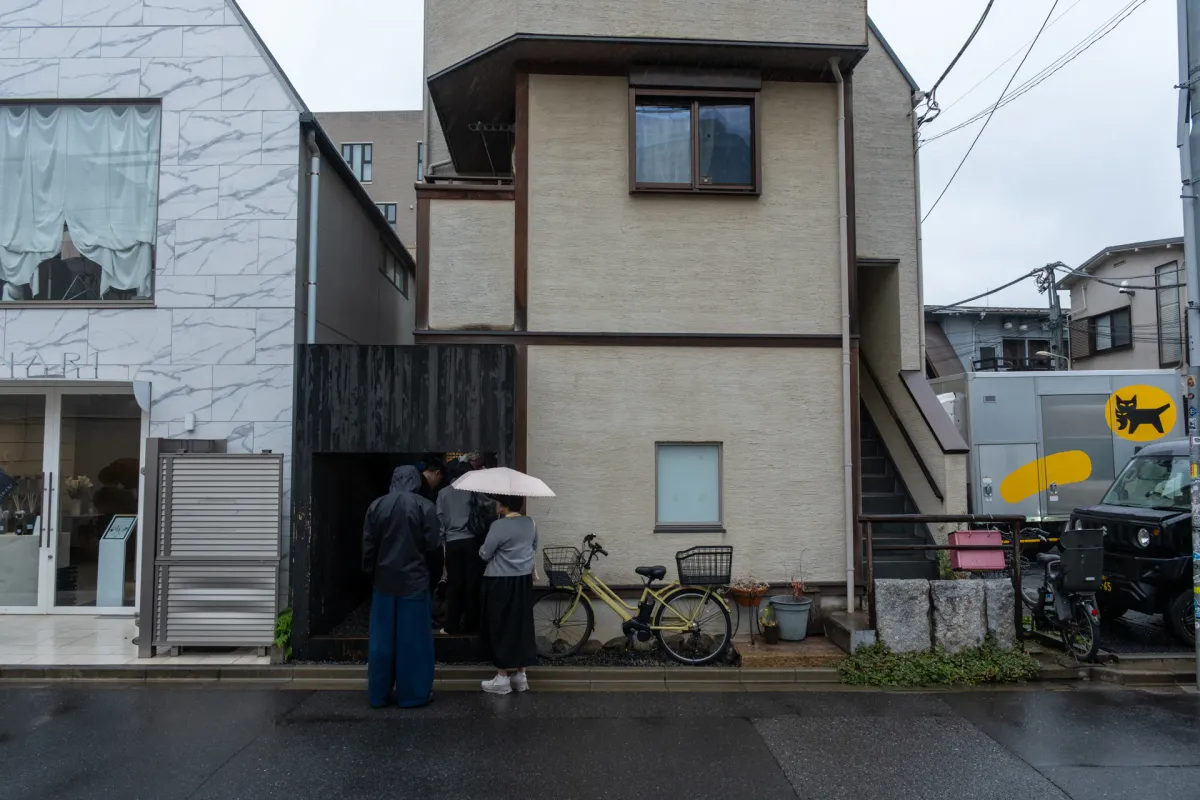
Koffee Mameya, a specialty coffee bean store near Shibuya, had always been on my radar to visit but I had never quite gotten around to it. Its reputation precedes it - I had a coffee-loving work colleague in Australia recommend it to me (which just goes to show how widely known it is) and so I was always afraid of the inevitable lines outside.
Well, on a rainy Friday morning I decided to brave the line, hoping that it might be shorter due to the poor weather. Alas, not really - I still waited about 40 minutes in line, but I’m glad I finally got to visit it so I can check it off my list.
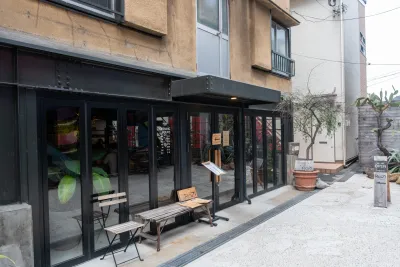
The storefront itself is very innocuous. It looks to be on the 1st floor of what is otherwise a regular Japanese home. There’s no sign on the outside, so you wouldn’t really know what people are lining up for.

It’s only once you join the line and you get closer to the actual entrance that you can see the 6x6 grid, which is the logo for the store, but nothing else.
Unlike most of the other coffee bean stores that I like to visit in Tokyo, the unique selling point of Koffee Mameya is that they don’t roast their own beans. Instead, they source their beans from roasters from both Japan and around the world. When I went, they had coffee beans from international roasters like Homeground Coffee (Singapore), La Cabra (Denmark) and Rose Coffee (Zurich).
In terms of Japan-sourced beans, they had beans from Leaves (near Asakusa), Mame Polepole (Okinawa), Tokado Coffee (Fukuoka) and Ogawa (Kyoto). In chatting to the barista, he told me that they swap out the beans as they run out, which tends to be every couple of weeks, so they always have a rotating selection of beans available.
As they don’t roast the beans themselves, Koffee Mameya instead prides themselves on their brewing method, so after you chat with a barista and choose a bean, you can watch the pour-over process happen right in front of you. If you’re not a fan of pour-over, the other option available is straight espresso (no milk).

A cup of coffee ranges from the cheapest at 550 yen - an espresso using a dark roast blend bean - which I assume is only on the menu just in case anyone walks in and gets shocked at the prices. The next cheapest cup is a pour-over with a dark roast at 700 yen for single origin, with medium roasts around 800 - 900 yen, and then it goes all the way up to 3,000 yen for a cup of a light roast Geisha bean.

They had 4 baristas on rotation when I went in. There’s counter space available for 3 to work at the same time, so in the interest of efficiency, the 4th barista will come out to the next person in line, and discuss bean choices. Once one of the counter spaces has freed up, that same barista will take you to the counter, so you stay with the same barista for the entire time. The baristas all seemed to be fluent in English, which is convenient as 90% of the people there were foreigners.

Enjoying a cup of light roast pour-over
As you get to ponder your bean selection together with the barista, you’ll be given a sheet with all the current beans available (you can take this home with you). The sheet itself is quite brief - just listing the bean name, roaster name and country of origin. Plus the colour of each square indicates its roast level.

Otherwise you’ll have to rely on your barista to explain the differences in flavour between each of the beans. There’s also not an opportunity to get a whiff of the beans before you pick one, which is a bit of a bummer since many places in Japan tend to do that.
Since I didn’t particularly want to spend 2000 yen on one cup of coffee for me it was a toss-up between the two cheapest light roast options. I chose to get a cup of the Costa Rican Finca Voo Red Catuai bean from a Melbourne roaster called Code Black (900 yen).

I am going to be completely honest here and say that I wasn’t in any way left with a sense of “wow” when I sipped the cup. For sure, it wasn’t sour, which is good, but it didn’t taste that exciting either. I think there’s a bit of a gap here as you spend 30 - 40 minutes waiting in line, which really raises your expectations. So when you get a fairly normal cup of pour-over, it’s a bit like “well, is that it?”
I found that I had enjoyed the cup I had had a couple days earlier at Mermaid Coffee Roasters way more (that was delicious, and no line!) And also the beans I got to try at Glitch Coffee tasted better as well. I will note I might be super-biased here as at both Mermaid and Glitch I got to drink the Pink Bourbon bean which I’ve found to be one of my favourites.
I think if you are willing to fork out 2000 or 3000 yen for a cup, or you’re just visiting Japan and this is your one-and-only experience with pour-over coffee, you might be more impressed with what you get, though.
Choosing some coffee beans to buy

And then next, the beans - I’ll admit for me it’s a bit of a shock at the prices here. Each bag is 140g, and the cheapest light roast available is 5,000 yen and prices go up to 20,000 (!) yen on the higher end. For a medium roast, you can get a relatively more “affordable” 4,000 yen bag. The cheapest bag is 2,000 yen for the blend espresso bean, or 3,000 yen for a single origin dark roasted bean.
For reference, and comparing this against other coffee bean roasters that I’ve visited in Japan - for 100g of single origin beans, I tend to see prices in the range of 800 yen to 2,000 yen. And those 2,000 yen beans are generally fancier light roasts. I’d consider paying 2,000 yen for 100g of coffee to be on the bougie end and it’s not something I’d do every day.
Since I was here, I wasn’t really going to walk away without at least trying some beans, so I bought Mame Polepole’s Kenyan Mitondo washed bean for 4000 yen, which is at a medium roast.

Koffee Mameya are quite conscientious here and will give you a little cardboard sheet with the recommended pour-over temperature and method, plus water/bean ratio. They even give you a sample of the ground beans so you know how finely to grind them. They told me I could drink the beans straight away, as they had been roasted a couple of weeks before. As they are sealed with gas, as long as you don’t open them, you can hold onto them for up to a couple of months without the taste deteriorating.
How much of a markup is there?
Since Koffee Mameya exclusively deals in selling beans from other roasters, I was quite curious how much it would cost to just buy the bean directly. Of course, this is not taking into account shipping fees, which would probably be quite high from another country to Japan, but just out of curiosity’s sake:
Code Black’s Bolivia Las Alasitas Gesha
- Koffee Mameya: 20,000 yen for 140g
- Direct: $122 AUD for 250g (~14,000 yen at current exchange rates)
Leaves’ Panama Elida Loma Geisha
- Koffee Mameya: 17,500 yen for 140g
- Direct: 6,200 yen for 100g
Mame Polepole’s Kenya Mitondo Washed
- Koffee Mameya: 4,000 yen for 140g
- Direct: 1,782 yen for 150g
Note: the links might be broken by the time you read this as the roasters may take down the listing once they sell out of the bean.
In short, you really are paying for the sommelier-like experience, where the barista will recommend you a bean and walk you through how to roast it. At the back of the store, you can also see the employees sifting through the beans and picking out the imperfect ones - so maybe they are of a slightly higher quality than if you bought from the roaster directly.

I think in my case, budget-wise I limited myself quite a lot in what beans I could choose. So I didn’t really find the sommelier experience to be that useful for me, or worth the price premium. My other takeaway from this is that I had heard of Leaves Coffee before, so seeing it listed as one of the available beans bumped it up on my list to go check out their store (and get their beans at a much cheaper price).
I did notice one lady grabbing at least 6 bags of beans. I suppose it can also make for a good souvenir or gift, plus you can efficiently buy beans from a lot of different roasters in one place. However as a Japanese local, the prices are quite high so it’s pretty hard to stomach. Not to mention if you head to any local roaster in Japan, the staff there are always more than happy to give you their opinions anyway, so I’m not sure the sommelier-like experience you get here is really that valuable.
Koffee Mameya does get extra points for the packaging - the bag of beans itself is fairly plain, but it comes enclosed in a cloth drawstring bag which is quite cute.

Drinking the beans at home
And finally we get to the bit where I talk about the actual taste of the beans I bought - Mame Polepole’s Kenyan Mitondo washed bean, at a medium roast. The store recommendation was to do it at a 1:15 ratio (14g beans : 210g water) at 90°C, with a medium grind. I did it at my usual 15 clicks on my Timemore C2.
So the first thing that stood out about the bean itself was that weirdly, it smelt like tomatoes. Reddit comments is probably a weird place to do my research, but it seems I’m not alone in thinking that Kenyan beans can sometimes have a tomato flavour.

As for the taste itself? At first it was quite sour, especially at the recommended temperature. My barista did tell me that if it seemed like it wasn’t ready to be drunk yet, I could let the beans rest for a bit to see if the taste would improve. Over the course of a week I went back to my normal 1:16 ratio (15g beans : 240g water), experimented a couple of times, and eventually settled on 96°C with a finer grind (12 clicks). Either with the passing of time, or the changed setup, I was able to mostly reduce the sour aftertaste into something that was drinkable, and tasted quite nice.
But considering I paid 4000 yen for this, I really didn’t get that “wow” factor that I would hope at that price range. Assuming that I could have bought this same coffee for 1,782 yen directly from the roaster, at that sort of price range I would categorise it more as a “reasonable/good taste for the price”.
This was only my second time buying and drinking a Kenyan bean. The first time I drank it was with a dark roast at 75°C (from Sugamo’s Honey Beans) which I don’t think is much of a fair comparison either since the roast level would drastically change the taste (but I quite liked that one!) So maybe it’s possible that I’m just not really that much of a fan of the bean generally. Reddit also seemed to recommend trying “cupping” to try and understand the taste a bit better, so maybe I’ll have to give that a go sometime.
As a final side note, while net-surfing on what a Kenyan bean is supposed to taste like, I came across this article from Christopher Feran on the Kenyan coffee bean industry which seems to be experiencing some issues. It was rather interesting and well worth a read.

Hi, I'm Emma!
I'm a long-time lover of coffee - back in Sydney my go-to drink was always a soy cappucino. After I moved to Tokyo 4 years ago, I discovered the wonders of pour-over coffee and now I'm always on the lookout for new coffee beans to try. So far I've checked out 31 coffee shops and roasters here in Japan.
If you found this post useful, you can also show your support by buying me a coffee ☕
Comments
Hi, thanks for a detailed account!
I agree on the markup on the beans, it's quite significant.
I'd say queueing for 40 min at Mameya only makes sense if you purchase and sample the higher end of their offerings. This is a place ideal for people who are looking for more extreme beans and want the full experience. I'd say you should buy the same beans that you tasted at Mameya to get the idea of how they should taste when you later brew them at home. The place is "novice friendly" in a way - if you describe what you usually like to drink, they will find something suitable. If it's a medium roast nutty chocolatey comfort batch brew - they have that but it's in the nothing special 600-900 yen range. The really nice coffee is at 1500+ a cup, and you need to ask for sweet yet floral, strongly fruity or unique coffees.
Hey Kris! Yeah, I would say I didn't do enough research on this place so I was quite surprised at the prices once I got to near the front of the line and could see the menu. I think an upper range for me might be 1200 - 1500 yen, so when I saw the jump in price between the 950 yen cup and the next-cheapest cup being 2000 yen, I couldn't quite bring myself to spend that much money (knowing I wanted to buy some beans as well)! For sure it's novice-friendly, and I'm sure helpful for tourists who just want to come to one place and get a wider selection of beans.
Leave a comment