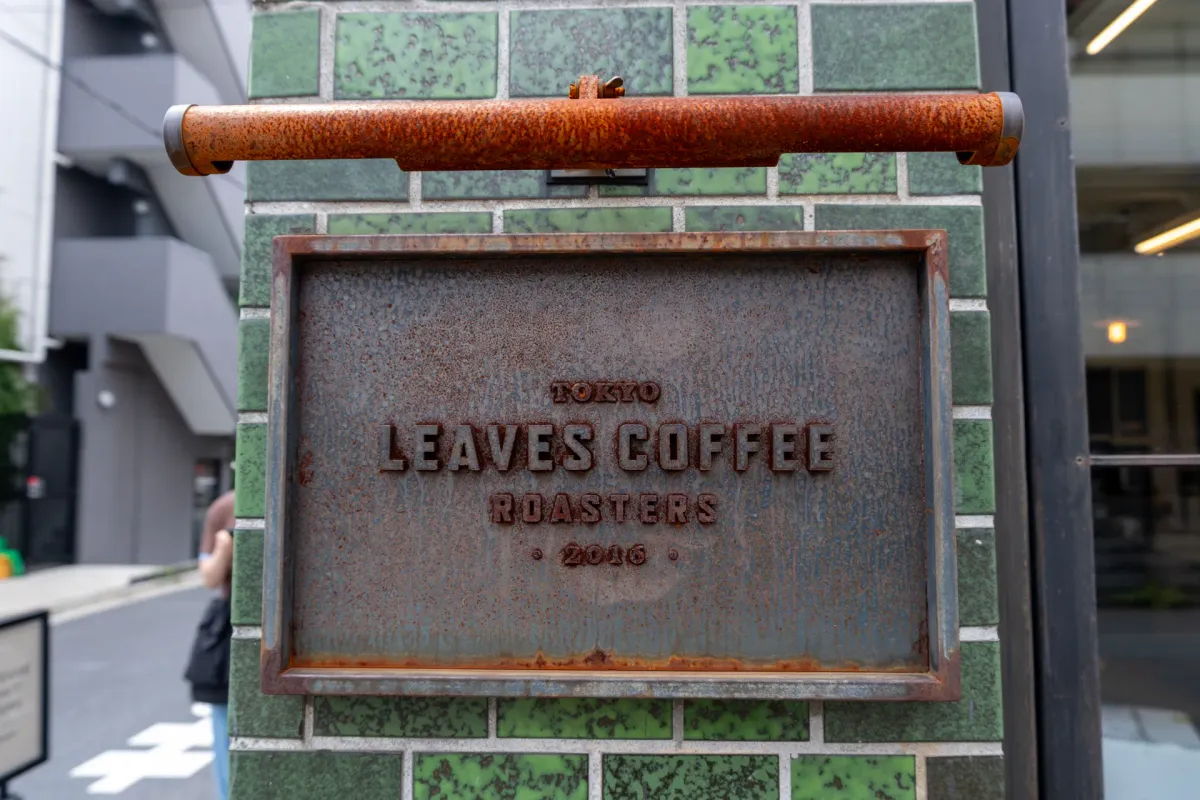
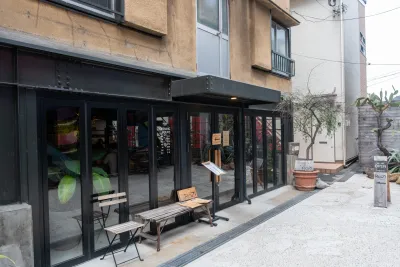
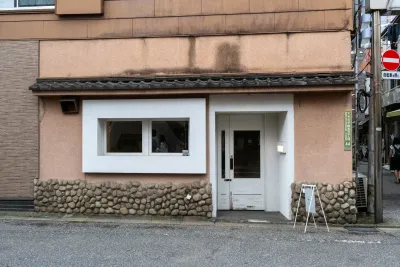
I recently ventured out to Asakusa to visit Leaves Coffee Roasters. Along with Glitch and Koffee Mameya, these three shops seem to be the trifecta of Tokyo pour over coffee shops commonly recommended on the internet. I mentally prepared myself for the long lines of tourists - but to my pleasant surprise when we showed up about 10 minutes before the store’s opening time, we were only the third group of people lining up. So we easily made it into the store when it opened at 10am.
Leaves Coffee Roaster exclusively sells light roast coffee and are best-known for their pour-overs, but you can also get espressos and milk-based coffee as well. The store has a rather interesting setup where everyone sits along one wall of the shop, all facing forward and looking at the baristas behind the counter.

Whether the seating layout of this store is an intentional decision or just an unavoidable setup due to the limited space in the store, who knows. But it definitely lets you watch the show the baristas put on for you as they make your coffee.
Once guided to your seat, you’ll be handed a small menu where you can ponder your bean choices. Once you’re ready, you can head up to the counter and make your order.


Watching the Leaves baristas at work
The first thing we noticed was that one of the customers before us had ordered some sort of cold coffee drink. In that case, rather than putting ice cubes straight into the hot coffee, it seems instead they will give your pour over a little ice bath - all the while holding a temperature gun to make sure the temperature of your drink has sufficiently cooled enough.

Secondly, the pour-over setup.
As the barista preps his equipment to begin making your pour-over, he will pull out a leveller to make sure that the rim of the dripper is completely level.

Then he seemed to alternate between 2 separate kettles of hot water as he begins his pours. At first I thought this was some kind of special technique where he was doing different pours at different temperatures.

But as we watched his process through making multiple cups, our theory is that as you use the kettle, it will naturally drop a degree or two in temperature over time. So by consistently swapping between the kettles (and letting them re-boil back up to the required temperature each time) you can more consistently maintain the existing temperature for the entire pour.
And then finally, after each little swirl of hot liquid, he will also get real close and take a big whiff of it (didn’t get a photo of this one).
Interestingly, he doesn’t seem to take a taste test before the cup is handed over to (many baristas do) which suggests that the sniffing must really be doing something - or he’s so good he knows what it’s going to taste like.
Our pour-over coffee choices
We ordered a cup of their Kenyan Gathaithi AA bean (900 yen), plus their Costa Rica Don Eli Yellow Bourbon (1500 yen).

The Kenyan bean was quite light and smooth with some hints of berries like on the tasting card. The Costa Rica was a bit more acidic, which after many cups of coffee I’m starting to understand that this is just the characteristic of a Costa Rican coffee bean. It was decent, but for us it didn’t necessarily feel worth the price jump over the Kenyan one.


Overhearing the hushed conversation of the couple seated next to us (and from the accent I could tell they were Aussies like me!) they mentioned that had liked the place they gone to the day before better - and that this place was pretty average.
For sure, I don’t really think the sniffing and the levelling and the kettle-swapping really made a difference to the coffee we got to taste (although it was funny to see). But funnily enough I didn’t really get a pretentious vibe either, like the baristas were trying to put on a show for us. I think they just genuinely felt like they wanted to make their coffee like that. I can respect that.

Overall the reviews on Google were quite good (4.5 stars) although there were the occasional negative ones. One of the recent complaints seemed to be that the store employees are quite cold and the store’s ambience feels quite clinical. And with everyone only daring to talk in hushed voices, it’s hard to hold a decent conversation.
For us, the staff were generally super cheerful and smiling at us the whole time so we didn’t get a cold sense from them. But if you are coming in with the expectation of a vibe of heading to your local coffee shop, grabbing a cup and having a chitchat with your friend, I can get why you might give this place a negative review as this is not the place to go for that.
As pretentious as it might sound, the store is more structured for you to enjoy the barista’s craft, then enjoy the coffee, and then leave. They had this orchestral, moody music playing as well which really added to this peaceful, “worship the coffee” kind of vibe. Not to mention both the guys in the store had inexplicably gone for a shaved, monk-style haircut (not sure if that is a job requirement or just for fun). I’m more of a quiet person by nature anyway, so I was quite content just to enjoy the show with an occasional bit of hushed chitchat.
We had a less pleasant experience at the next coffee place we visited - which made us ponder. When reviewing a cup of coffee, it’s not always 100% the taste of the liquid itself, right? The way it is presented to you, and the ambience of the store itself inevitably will influence your feelings and impression as you get to taste that tasty tasty liquid, and so for us, Leaves Coffee Roaster gets top marks for presentation.
Checking out Leaves’ coffee beans

Of course Leaves is also a coffee roaster, and so all the beans available as pour-over options are also beans you can buy a bag of to take home. These are prepackaged, with the date they were roasted stamped on.


You can also see their beans on their website but the prices range from 1800 yen for 100g of their Ethiopian bean, up to 9200 yen for some really fancy Geisha beans.

We bought two 100g bags:
- Kenya Gathaithi AA (1800 yen) since we quite enjoyed the taste of it in store
- Ethiopia Guji Uraga (2000 yen) since we weren’t the biggest fan of the Costa Rica one and wanted to try something different
The packaging of the beans looks like a plain white in the photo, but when you feel it has a bit of a rough texture and feels very premium.
Leaves’ recommended pour over method
The store also provides you with a recommended pour over method when you buy the beans. All beans come with the same card.

They recommend:
- 13g of beans, 200g of water (1:15 ratio)
- A temperature of 92℃
- A 30s bloom (30g), then a spiral pour (100g), then a final pour in the centre (70g)
The instructions are quite detailed, going as far as to mention the flow rate. Probably the most detailed instruction card I have seen, and to be honest I can’t quite stay on top of trying to watch the flow rate on my scale and watching the grams of water I pour on so I don’t think I’ve managed to quite follow it to the letter.

The back of the card is in Japanese, and mentions that you should wait at least 20 days after the roast date before beginning to drink your coffee (it does also say the same thing in English on the back of the actual bean packaging).
Leaves’ coffee beans: my verdict

Once at home (and we waited at least 20 days) we first opened the Kenyan bean. The first day I tried it following the store’s method and it tasted pretty good, actually. I could distinctly get a whiff of a tomato-y smell, which is similar to the Kenyan bean I got from Koffee Mameya but I found myself enjoying it more (which is partially probably because I felt less ripped off by the prices).
I initially ground it at 12 clicks, but I bumped it to 15 clicks (i.e more coarse) and I think that was the correct fine-ness. The tomatoy-ness of the Kenyan bean is growing on me. In a sense it’s a tiny bit acidic, but in a pleasant way.
Once we opened up the Ethiopian bean though, we could tell that we liked this one better. It has quite a fruity and sweet smell to it. Overall both beans were pretty solid, and I feel like were worth the price.
As a final note on the pour-over method, I was interested to see that they promote doing the second pour directed in the centre of the dripper. This results in a slightly more uneven bed of coffee grounds afterwards.

Compared to how I usually make my pour-overs (which involved doing more swirls plus some shaking at the beginning and end) which produces a super even bed (which is supposed to be a good thing).

To be honest I can’t really notice that much of a difference with either method, and the method Leaves’ uses is actually quite simple, so I might stick with it going forward.

Hi, I'm Emma!
I'm a long-time lover of coffee - back in Sydney my go-to drink was always a soy cappucino. After I moved to Tokyo 4 years ago, I discovered the wonders of pour-over coffee and now I'm always on the lookout for new coffee beans to try. So far I've checked out 31 coffee shops and roasters here in Japan.
If you found this post useful, you can also show your support by buying me a coffee ☕

Comments
The pour over with ice cubes inside the brewer has been apparently invented in Japan, and some places call it "Japanese pour over". :)
The slow/careful final pour in the center is intended to minimize agitation and give you a less bitter cup. They don't know your home equipment so this is a safety protocol, you could say.
Thank you for covering Leaves! Seems very reasonably priced, relative to Glitch / Mameya!
Ooh I didn't know that about the Japanese pourover. And yes, I thought that might be the case with the pourover technique.
Definitely cheaper than Mameya that's for sure, plus you get to buy the beans from them direct which is nice. I do wonder if I would have a better opinion of Mameya if I managed to get in without having to lining up, like I did with Leaves!
can you share the brewer and filters you generally use for your pour overs? I am in the process of evaluating Vector, Orea (several), and NextLevel Pulsar.
Thank you!
Hello Benjamin! For the brewer I use a ceramic Hario V60 - and the only reason for that is because my husband already had one of these when we moved in together (and that's what got me hooked on pourovers!) He doesn't really like plastics so that's why it's ceramic - the one downside is that it takes a bit more time to warm up so generally I pour some hot water on directly to warm it up.
But otherwise the Hario V60 is a fairly solid/standard brewer and I have no complaints (although tbh I've never really researched what other brewers are like, and I'd be curious to see what else is out there - let me know how you find whatever you end up buying!).
And then I just buy the standard v60 filter papers off of Amazon, although sometimes they don't stick super cleanly to the edge of the V60 walls.. I have seen one coffee shop put in a weight while they wet the filter paper which makes it stick better, so maybe that's an option.
Leave a comment