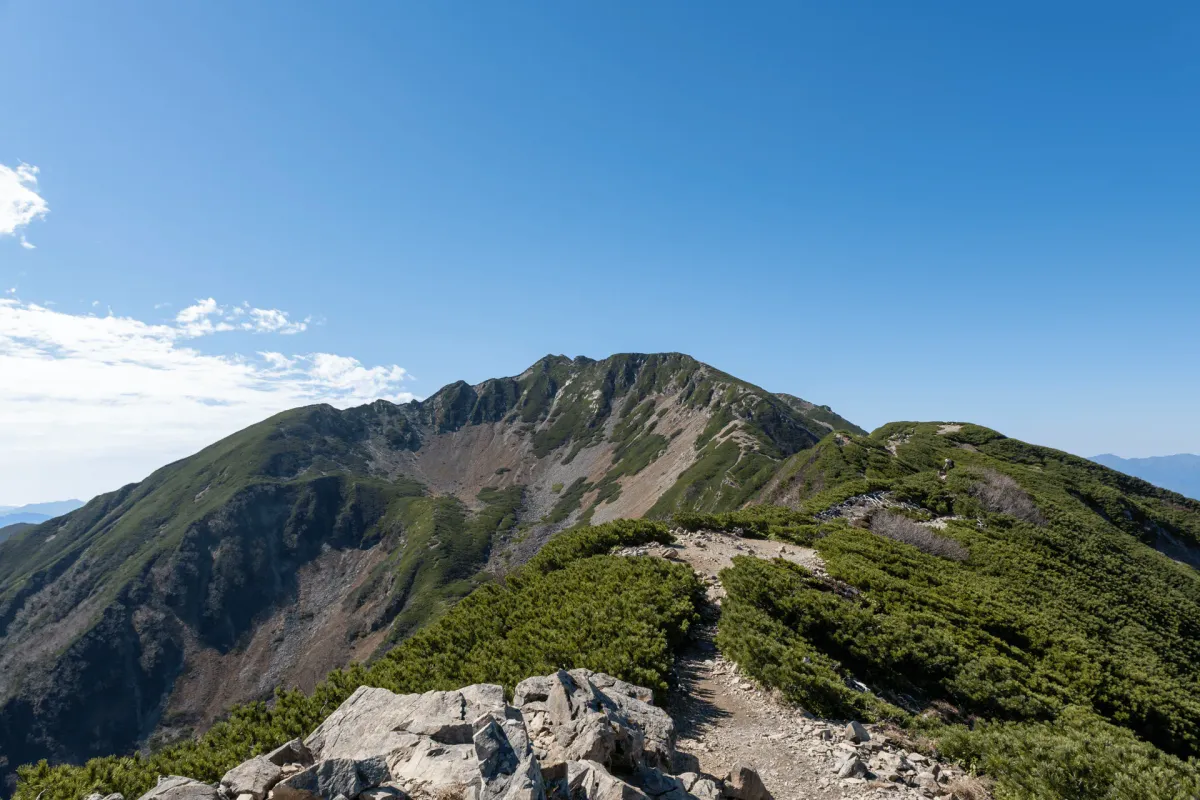
Hiking log
- Elevation 3033m
- When to climb July - October
- Standard course is a 7-hour, 9km hike from Kitasawa Pass (北沢峠).
Mountain stats
Take a bus from Chino station to Todai Park, then shuttle bus to trailhead. Total travel time from Tokyo is approximately 4 - 5 hours. Due to the timings, expect to spend a night in the area.
Park at Todai Park carpark (1000 yen), then take shuttle bus to the Kitasawa Pass trailhead.
Mt Senjo (仙丈ヶ岳, senjo-ga-take) is one of the Hundred Famous Mountains of Japan located in the Southern Alps. With a round-trip course time of 7 hours, it’s one of the more accessible mountains in the Southern Alps, which tend to feature a lot of mountains with overnight hiking courses. Thanks to its popularity (and probably the great views you can get from the top) it’s also known as the “Queen of the Southern Alps”.
The trail to Mt Senjo begins from the Kitasawa Pass (北沢峠) trailhead. Uniquely, from here you actually have two peaks available to climb - Mt Senjo and Mt Kaikoma. Their trails head out in opposite directions, and both take roughly the same amount of time to hike. For this reason, people will sometimes spend 2 days here to tackle both peaks, and camp or stay at the Komorebi mountain hut near the bus stop.

The first stretch of the trail is all in forest, with a fairly pleasant flat bit near the start as well. There were plenty of people about as we all got off the same bus and started climbing at around the same time.


Mt Senjo has a partial loop course which goes via the Umanose Hutte (馬ノ背ヒュッテ). The hut closed for the season in mid-October, and coinciding with that, it seems like they close the trail as well - so today the only course available was the out-and-back.


In a bit under 2 hours, I managed to climb out of the treeline to get my first glimpse of Mt Kaikoma - the other mountain available from the trailhead.


The peak may look very white, but it’s not actually snow - the summit is very sandy and is also made of granite. I could see some really pretty autumn foliage creeping up its side.

Before Mt Senjo, you’ll reach the peak of Mt Ko-Senjo (小仙丈ヶ岳). It was about 11am, or 2 hours into my hike at this point. And such good weather today!


From up here you can also see out towards Mt Fuji and Mt Kita - getting the first- and second-tallest mountains in the same frame. It had rained the day before, and I could see that was now a bit of snow sprinkled on the peak of Mt Kita.

If I squinted, it looked like Mt Fuji had got some snow as well - and it turned out that today (the 23rd of October) was officially the first day of snow for Mt Fuji!


As we kept climbing, I noticed two gentlemen with heavy packs - I was curious as to where they were going, and saw them take a right turn before the peak of Mt Senjo. It turns out there is another mountain hut just below the peak called Senjo Hut (仙丈小屋).

However, before they rounded the corner, I noticed they spent an awfully long time taking photos of a bush. I grew really curious - either they were just plant enthusiasts, or it was possibly a raichou.

I didn’t want to miss a possible raichou encounter, so I decided to head their way. And I was in luck!

This was my first time seeing a raichou so late in the season - I’ve only ever seen brown ones in the peak of summer, but they actually go fully white during the winter months, and so this one was starting to have her winter plumage come in at the bottom.


Once I had my fill of raichou, I headed back towards the main route up to the peak.


It was such great weather today, so the walk along the ridgeline towards the peak was really comfortable.


I made good time and arrived at the peak around 12:20pm.


From up here I could see down towards the Senjo Hut.


Today’s trail was a straightforward out-and-back, so after some photos and taking in the view at the peak, I started back.


I made it down to the Komorebi hut, where I was staying the night, just before 3pm.

The Komorebi hut has an interesting layout. Usually I find that the eating and hangout space is a little bit separated from the sleeping spaces, but in this case the two were adjacent to each other. Luckily you get a bit of privacy as each of the sleeping berths has partitions and curtains, but the noise does travel so I got to listen in on nearby people’s conversations as I dozed in my futon before dinner.


The hut does also have a second floor with more sleeping spaces, but I think due to today’s low occupancy, they just kept everybody on the first floor.

Dinner was some really, really good chicken and onion soup with rice and grilled chicken and salad. I planned for a 5am start the next day to climb Mt Kaikoma, and I had a really good night’s sleep.
Hiking course options
| Date climbed | Length | Course time |
|---|---|---|
| 2025-10-23 | 9km | 7h (the expected time for an average hiker without breaks) |
The standard course for climbing Mt Senjo is a 7 hour, 9km course from Kitasawa Pass (北沢峠). It’s mostly an out-and-back, but with a small loop section as you climb via Mt Ko-senjo, and then descend via the Umanose Hutte.
However when I hiked, the descent path via the Umanose Hutte was already closed for the season, so instead I just did the 8.4km out and back course which passes Mt Ko-senjo in both directions. It’s shorter in distance (8.4km vs 9km) and also takes less time (6.75 hours vs 7 hours).
When to hike Mt Senjo
The main hiking season for Mt Senjo is between July and October. The buses do start running in mid-June, but there still will probably be some snow left at that time, and it may begin to fall in the later parts of October as well.
Note also that the buses only run from mid-June to mid-November, so you will only be able to do the hike from Kitasawa Pass during this time. For those eager on a winter hike, you can hike from Todai Park to the Choei Hut (長衛小屋), but this adds an extra 17 km one way (!) to your hike.
It seems that the buses also stop running once the area has its first snow - e.g. the 2025 bus timetable was schedule to run the buses until mid-November, but they ceased operation on the 3rd of November instead. As this YAMAP activity notes, if there is unexpected snowfall the bus may attempt to take you to the trailhead, but have to turn back mid-way so keep this in mind as well if you are planning on hiking towards the end of the seaosn.
Shuttle bus from Todai Park

One of the downsides of hiking Mt Senjo and Mt Kaikoma (at least via the Kitasawa Pass trailhead) is that the trailhead can only be accessed via a shuttle bus from Todai Park (戸台パーク) that takes you on a 1-hour journey up the winding road to the trailhead. And with the popularity of these mountains, in the summer months the carpark and bus stop can become a bit of a battlefield. Note for example this YAMAP post from mid-July in 2023 which notes that nearly 1000 people lined up to catch the bus in the morning.

If you are coming in the peak season, luckily the bus company does put on plenty of buses to accommodate demand, but there are a few things to keep in mind:
- People will arrive the night before and sleep in their car. e.g. this mid-July 2024 post on YAMAP mentions the carpark was basically full when they arrived at 3:30am.
- Before lining up for the bus, you will need to buy a ticket from the ticket machine. The ticket machine is only in operation from the early morning until 5pm. So if you happened to drive over and arrive really early the day before, you could buy your ticket. Otherwise, you will need to line up for this first thing in the morning.
- There is then a separate line for the actual bus. You are allowed to leave a trekking pole, item of clothing, your backpack, etc. to reserve your spot in the line.
So the recommended strategy would be to arrive early and to reserve your spots for both the ticket machine and the bus line. If you are coming with at least one other person, that should be fairly straightforward.
Luckily, I didn’t have to deal with this problem, as I came on a weekday in October. By October it is getting quite cold, so there wasn’t really any big crowds (even so, they still put on 2 buses in the morning).

If you come in summer, the first bus departs from the carpark around 5:30 or 6am (depending on the day of the week). With the final return bus at 4pm, this gives you 10 - 11 hours to do a 7 hour hike, which is more than enough time. However if you want to do this as a day hike in September - October on a weekday, the first bus doesn’t leave until 8am, which means you get to the trailhead at 9am, and you have exactly 7 hours to do the 7 hour hike. So it’s quite a tight schedule in that case, and something to keep in mind.

You can check out the 2025 timetable to get a rough idea of the bus timings. Once the 2026 timetable comes out, you’ll want to search for it on Google via a search term like “戸台パーク(仙流荘) → 北沢峠”.
Staying at the Komorebi hut
I stayed at the Komorebi hut, which is right next to the bus stop at the Kitasawa Pass.

The hut booking can be done online at yamatan.net. As a reference, if you try and aim for weekends in July it is quite competitive. e.g. when I checked 2 months in advance, already weekends and Friday nights were booked out so you have to get in quick. However as mid-July approached, I could see spots start to open up again, so I guess people also do drop out depending on if their plans change (or maybe it was due to the weather).
If you are trying to aim for the weekends in July, even Friday nights get booked out - it’s very competitive, basically the day it gets released it already gets booked out.
In comparison, it was very easy to get a booking in mid-October, and I could see that there were free spots available on the weekends as well.
If you are planning on arriving at the Kitasawa Pass in the morning and then doing a day’s hike, the hut asks that you check in before you begin your hike. You will have to fill out their intake form - so if you are in a hurry, you can print it out beforehand so that you can directly hand in that paper when you check in. They require you to finish your hike by 4pm.
The great benefit of this hut is that it means you don’t have to worry about over-packing - once you get off the bus, you can drop off anything you don’t need for the day hike, like your change of clothes, or other things you won’t be needing until the next day. Great if this is your first time staying at a hut and you aren’t too sure what to bring!
Alternatively, the two other huts that I’ve mentioned in today’s blog post are:
- The Umanose Hutte
- The Senjo Hut
And if you are looking to camp, the Komorebi Hut itself doesn’t have a campground, but there is the nearby Choei Hut (長衛小屋) which does have a campsite.
Public transport access
If you are coming via public transport, you will first have to get a bus to Todai Park (戸台パーク) before then getting the shuttle bus up to the trailhead. In 2025, they were running the “South Alps Geoliner” (南アルプスジオライナー) bus from Chino station (茅野駅) and Inashi station (伊那市駅) which you can see the PDF for here.
If you are coming from Tokyo, you will probably be getting on the bus at Chino Station. Your rough itinerary would look like:
- 7:30am depart from Tokyo
- 10am arrive at Chino station
- 10:40am get on the Geoliner bus
- 11:40am arrive at Todai Park
- 12:10pm get on the shuttle bus
- 1pm arrive at Kitasawa Pass
Which would give you plenty of time to check into the hut or set up your tent before you do the hike the following day. Or maybe you could stay at the Senryu-so Hotel at the carpark as well.
The return bus is at 5pm. If you have a long wait while at Todai Park, there is an onsen available for day use at the Senryu So Hotel (仙流荘).
Car access details

The carpark at Todai Park is a large gravel field - make sure you don’t park in the concreted section near the bus stop, as this is for guests who are staying at the Senryu-So Hotel. The carpark costs 1000 yen, which you will pay in cash to an attendant when you leave the carpark.
If you are attempting Mt Senjo during its peak season (summer, on the weekends), I would recommend arriving early and sleeping in your car to make sure that you can get a spot.

Read more
Support me
📸 Thanks for reading! If you'd like to read more posts like this one, you can follow me on Instagram to stay up to date on my hiking adventures.
If you found this post useful, you can show your support by buying me a coffee - I write this blog for fun, but coffee is always appreciated! ☕
Recent posts
 hikes
hikesMt Nokogiri: a hike to Chiba's stone quarry
18 Mar hikes
hikesMt Miura-fuji and the Miura Kaigan Cherry Blossom Festival
9 Mar hikes
hikesAkabokko: hiking in Ome
16 Feb
Leave a comment