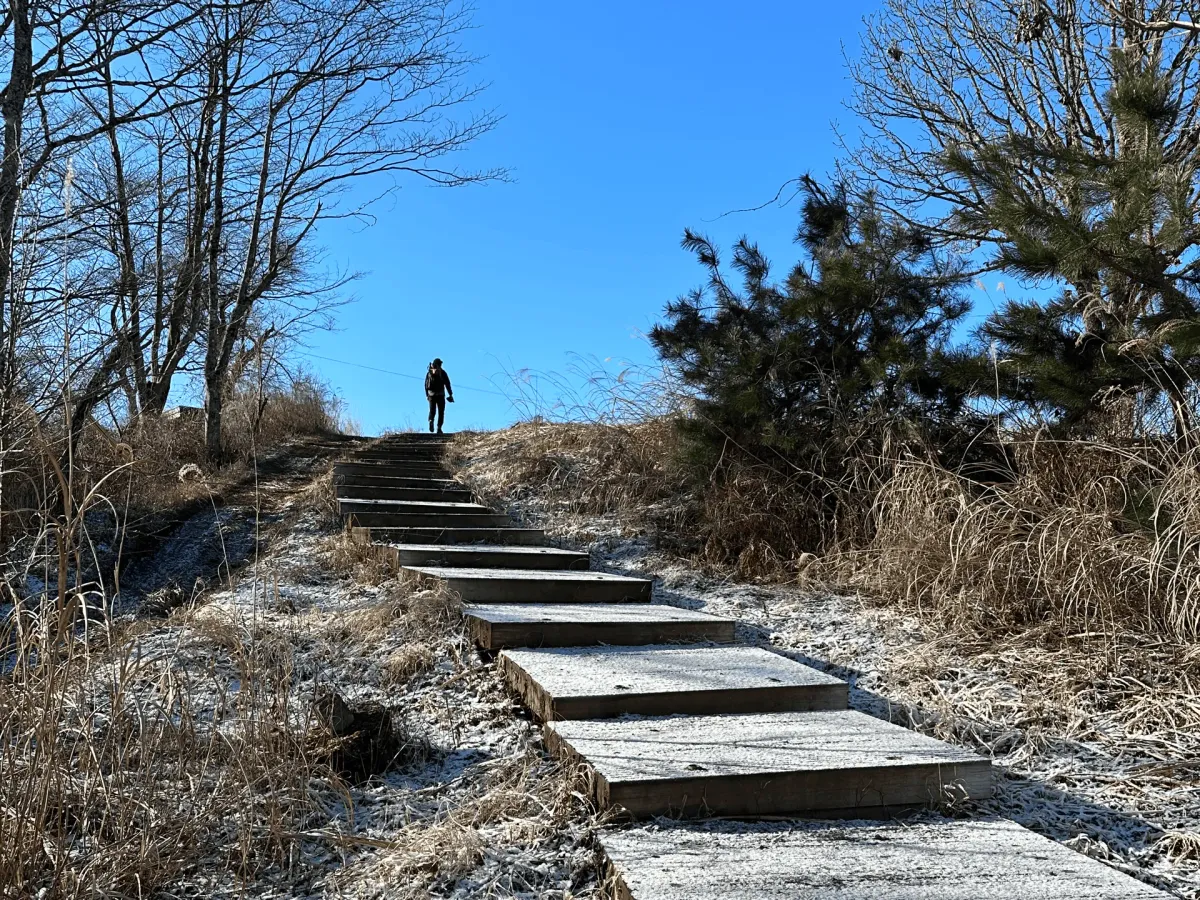
When I first moved to Japan, I wondered what do hikers do in winter? If you are interested in snow hiking, a whole new world of opportunities open up, and winter sports like skiing and snowboarding are a popular option too. However both involve a lot of extra equipment you need to buy or rent, and arguably there is a small risk of injury too. If you just want to stick with snow-free mountains, there are still plenty of options around Tokyo, even in February (the coldest month in Japan).
Tips for hiking in the winter
My general rule of thumb for winter hiking in Tokyo is:
- Mountains under 500m elevation are snow-free all months of the year
- Mountains at an elevation of 1500m are still snow-free in December and for part of January. But a no-go in February and parts of March.
- For mountains in the 500 to 1500m range, it’s a bit more variable, so I always make sure to check the trail conditions before my hike on YAMAP.
However, Tokyo generally gets a day or two of snowfall per year. So I would expect that if it happened to snow in Tokyo, even the lowest elevation mountains may have some snow on it.

Double-checking trail conditions on YAMAP is always a good idea. I’ve assumed that there would be no snow on a mountain, and then run into it near the summit a couple of times before!

Staying warm is key for winter hiking, so I recommend bringing a lot of cold weather gear - like gloves, a knit cap, and lots of removable layers. Usually in winter I will wear 5 layers: a thermal undershirt, another long-sleeve thermal/shirt, a thin fleece jacket and thin down jacket, and finally a raincoat/windproof jacket on top of that. I usually take off 3 of these layers as I warm up on the hike up, but tend to put all of them back on when I take breaks or when I start descending, as your body will chill quite quickly.
Cup ramen is also a common sight on the mountain-tops in Japan, with some hikers bringing along a small burner to boil their water at the summit.

Sometimes I see people attempt to make their cup noodles only with a thermos of hot water, with varying results. If your thermos doesn’t retain all of the heat, you end up with a kind of sad ramen that hasn’t quite cooked through. Bringing both a thermos and a burner if also an option if you don’t mind the weight, as this can reduce the time to boil your water (it can take quite a while in winter).
I’ve also got 12 winter hikes listed below, which I’ve all had experience with hiking in January and February.
Mt Takao, Tokyo

Mt Takao
Mt Takao is by far the most popular mountain in Tokyo, with hiking trails accessible in all seasons. With cablecar access, you’ll be at the summit in less than an hour. If you’re looking to escape the crowds, the 15km Minami-Takao Seven Summits course is a great winter option too, taking you on a loop around some of Takao’s lesser-known peaks.
Mt Jinba, Tokyo

Mt Jinba
Directly next to Mt Takao is Mt Jinba, which can also be climbed in winter without issues. Mt Jinba is traditionally done as a traverse hike to Mt Takao taking about 6 - 7 hours. I would recommend it if you’re looking for a slightly longer hike, and want to skip the crowds.
Akabokko, Tokyo

Akabokko
Akabokko is a 410m peak overlooking the town of Ome on the western edge of Tokyo. The course only has about 500m of elevation gain, so it’s a pretty beginner-friendly option, and comes with some great views from the peak. It’s also a convenient station-to-station hike from Miyanohira station to Ome station, just a 90 minute train ride from Tokyo.
Mt Nokogiri, Chiba

Mt Nokogiri
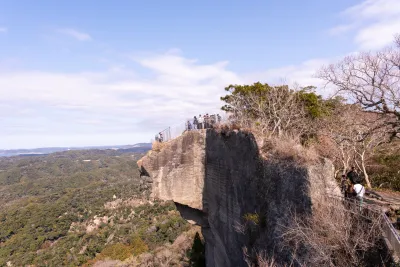
Mt Nokogiri is one of Chiba’s most popular hikes, and thanks to its low elevation it can be climbed year-round. It’s a nice hike with a lot of points of interest - a huge quarry, the “hell’s lookout” near the peak, plus the largest stone-carved statue of Buddha in Japan. The hike is beginner-friendly as it’s quite short, and there’s options to take the ropeway to make it even easier as well.
Numazu Alps, Shizuoka

Numazu Alps
The Numazu Alps is a series of low-lying mountains in Shizuoka. You get opportunities to see out to the city of Numazu, as well as Mt Fuji if you’re lucky. Conveniently, it has public transport access with the option to do a 14km point-to-point hike, which starts and ends at a train station. Optionally, you can take a bus from the station to partway along the route to make your hike shorter. This one’s a good option if you’re looking to get in a longer hike with some ocean views.
Hanno Alps, Saitama

Hanno Alps
The Hanno Alps are a set of low-lying mountains in Saitama. The southern stretch of the course passes by Mt Tenran, and has a max elevation of only 446m, making it suitable for winter hiking even in February. The northern section passing by Mt Izugatake has a max elevation of 851m, so there may be some snow in February, but it has a number of sculptures to check out and makes for a pretty interesting hike.
Mt Miura-Fuji, Kanagawa

Mt Miura-Fuji
Mt Miura-Fuji (三浦富士) is a bit of a niche mountain, but its hiking course is actually an excuse to stop by the Miura Kaigan Cherry Blossom Festival, held each year in mid-February to mid-March. Unlike the more famous Japanese sakura which bloom in March or April, the winter Kawazu-zakura cherry blossom begins to bloom in mid-February in a more vivid pink. The course starts from Keikyu-Nagasawa Station (京急長沢駅), takes you up to Mt Miura-Fuji and Mt Take-yama (武山), and ends at Tsukuihama Station (津久井浜駅). Once you’ve finished your hike, the festival is only 2 mins away by train at Miurakaigan Station.
Mt Hodo, Saitama

Mt Hodo
Mt Hodo is a mountain in Saitama’s Nagatoro Alps. With direct train access to the start of the trail, you’re looking at a course time of under 4 hours. I’d recommend timing your hike for March, when its yellow wintersweet flowers (ロウバイ) are in full bloom.
Public transport access is via a 2 hour train from Tokyo to Nogami station (under 2000 yen). Taking the point-to-point course, you’ll be passing through Mt Hodo and ending your hike at Nagatoro station where you can hop on a train back to Tokyo.
Alternatively, to significantly shorten the hike you can start and end your hike at Nagatoro station. There is a ropeway from here that will take you up most of the way to the summit.
Mt Kuki, Yamanashi

Mt Kuki
Mt Kuki is one of the Hundred Famous Mountains of Yamanashi and a great opportunity to get a view of Mt Fuji. It sits along the Chuo train line, so you can start and end your hike at a train station. The most popular course is an 8km station-to-station hike that also passes Mt Gozenyama, taking about 5 hours. You’ll get views of Mt Fuji along the way, especially from Tengu Rock viewpoint.
Mt Kintoki, Kanagawa

Mt Kintoki
Mt Kintoki is a beginner-friendly hike in Hakone, accessible via a 2-hour highway bus from Shinjuku. From the summit you can get views of Mt Fuji and pose with the large axe that serves as the peak marker. The shortest course is a 3-hour loop from Kintoki Shrine. For a longer option, you can traverse to the neighbouring Mt Myojingatake which comes with some really pretty ridgeline views, before you descend off the mountain and get on a bus back to Hakone.
Mt Buko, Saitama

Mt Buko
I’ve hiked Saitama’s Mt Buko at the end of January snow-free, and at the beginning of March with a tiny bit of lingering snow. It can be quite variable — there’s an example on YAMAP of late March 2024 still having snow on the trail. Mt Buko has a 15km point-to-point course if you are using public transport — it starts and ends at a train station, which is super convenient. There is a more manageable 7km loop course, but this will require a car.
Mt Ishiwari, Yamanashi

Mt Ishiwari
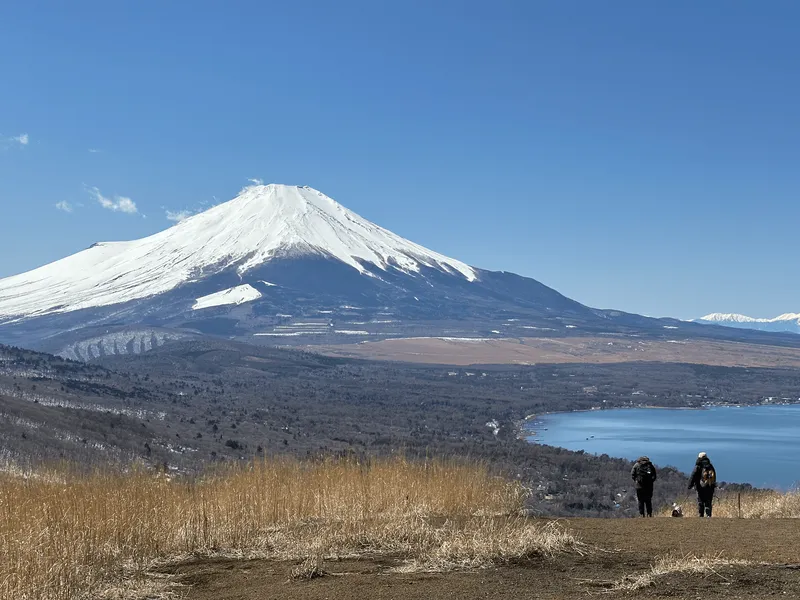
Mt Ishiwari is a mountain right next to Lake Yamanaka-ko, and great if you’re looking to get up close and personal with Mt Fuji. I’ve climbed it in early January of 2023 with no snow, although looking at YAMAP, snowfall seems to start from late January and persists until mid-March.
Mt Tonodake, Kanagawa

Mt Tonodake
Kanagawa’s Mt Tonodake (塔ノ岳) has great viewpoints for seeing Mt Fuji. I’ve climbed it in December and mid-January without any issues. March is more variable — in 2024 there was no snow by mid-March, but in 2022 there was still fresh snowfall at the beginning of April.
There are two course options:
- A 13km out-and-back course starting and ending at the Okura (大倉) trailhead, a 15min bus ride from Shibusawa station
- A 14km point-to-point course starting at the Yabitsutoge trailhead and ending at Okura, about 40 minutes by bus from Hadano station — more varied and with longer views of Mt Fuji
Other day hikes near Tokyo
If you haven’t checked it out already, my Tokyo day hikes post has a number of other low-elevation hikes if you’re looking for more ideas. I also have a post on hikes around Mt Fuji if you’re looking for a few more options.
Happy hiking!
Read more
Support me
📸 Thanks for reading! If you'd like to read more posts like this one, you can follow me on Instagram to stay up to date on my hiking adventures.
If you found this post useful, you can show your support by buying me a coffee - I write this blog for fun, but coffee is always appreciated! ☕
Recent posts
 hikes
hikesMt Nokogiri: a hike to Chiba's stone quarry
18 Mar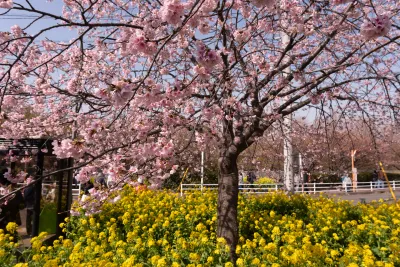 hikes
hikesMt Miura-fuji and the Miura Kaigan Cherry Blossom Festival
9 Mar hikes
hikesAkabokko: hiking in Ome
16 Feb
Leave a comment