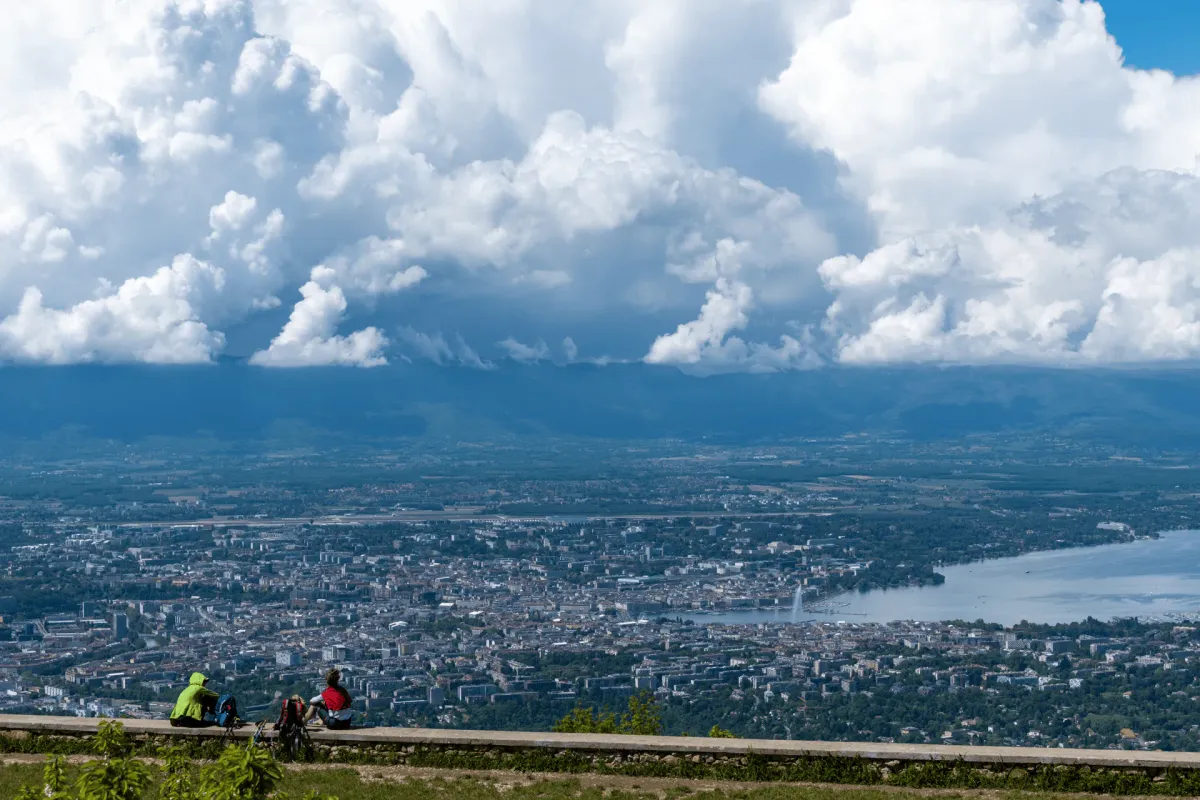
Mont Salève, known locally as the “Balcony of Geneva”, is a small peak that overlooks the city of Geneva in Switzerland. Funnily enough, although it’s considered to be Geneva’s local mountain, the entire mountain is actually located in France. The peak is accessible via a cable car, so you can skip the hike and head straight to the top if you just want to enjoy the views. Of course for me, if there’s a mountain I want to climb it, so I decided to follow SwitzerlandMobility’s route 144. This course takes you via the Swiss villages of Sierne and Veyrier, before heading into France and climbing the mountain.
30 minute bus ride from Geneva city centre. Take bus line 8 (TPG) to Veyrier, Pont de Sierne.
- Route 144: Veyrier, Pont de Sierne → summit (cable car down)mediumBus3 hrs·7 km·↑ 780m
April - October
The specific trail I took was to the top of the cable car, which is at an elevation of 1097m. When I was researching this peak before my hike, I assumed this was Mont Salève’s highest accessible point. However the highest point is at 1379m, at a peak specifically known as the Grand Piton which can be hiked from the French side.
Was this Mont Salève hike worth it? I would say the views from the top are amazing - and the portions of the hike have its merits - but some parts of the Route 144 trail were also a little boring so this particular trail might be on to skip in favour of trying out the Grand Piton trail. However I only had access to public transport and only the time for a short day hike, so this was a great hike for my situation. Not to mention I got to check off my first French mountain while on a trip to Switzerland!
Passing through Sierne
The hike begins at the “Veyrier, Pont de Sierne” bus stop. I had a mild moment of panic when I got off the bus and realised my phone didn’t have any reception - and I hadn’t downloaded a hiking map. It wasn’t really clear where I was supposed to head to, either. My hike up Mt Rigi a couple days prior had been very well sign-posted and my brain was in holiday mode so I had been taking things pretty chill.

Luckily I saw a lady head up a path across the road, and then my phone got network signal so I could double-check the map, and I was on my way.
You’ll first pass a small village called Sierne. Well, it’s technically a hamlet - it’s smaller than a village, since there’s only a couple of houses. It’s very pretty, and apparently quite old - the SwissMobility route info mentions that the buildings are from the 17th century.

There’s a fork nearby to the main hiking path.

As I walked down the gravel path, I took a look at my map and realised I was in France. I’ve only ever lived in island countries (Australia and Japan) so the idea of being able to walk across a border into a new country was new to me. I sort of expected there would be more fanfare or a big line in the ground, but I guess not!

As you walk the trail you’ll also spot Salève and the cable car heading up the middle. It had been cloudy in the morning, so I did some sightseeing in Geneva and started my hike just after midday once the clouds had started to clear up. I’m glad I got to spot the mountain from here! It’s always fun when you get to see the mountain in its entirety as you approach it.

From here you do another border crossing back into Switzerland. Now that I knew what to look out for, I could see the gate that marked the border line.

Passing through Veyrier
Next you’ll pass through the Swiss village of Veyrier. Today was a weekday and there were only some locals around, so I’ll admit I felt a bit out of place as I passed through.

And then before I knew it, I had crossed into France again! It was only when I crossed a road and looked back that I realised that I had passed a checkpoint building.

Not that there was any checking being done at the checkpoint - cars were just streaming in and out of Switzerland. But you could see quite a few security cameras attached to the building so I suppose they were at least monitoring the entry and exits.
Past the border, you’ll walk past some more houses and take a bridge over a busy highway road. I’ll admit that for as much solo hiking that I do, I’m still a bit of a nervous hiker at times and I was starting to doubt whether this was a proper course that people actually took, since it felt so residential.

Beginning the actual hike
But luckily just beyond this point the actual hiking course begins - a dirt path heading into the forest. I also saw another lady hiking up from behind me, so this reassured me as well. I know some people love empty trails, but personally I feel a bit better when I see the occasional person around.

I passed a rock staircase, which I could see was partially carved out of the cliff-face on the right. The route 144 page tells me that this is from the 14th century? Pretty cool if that’s true.

You’ll also pass a spooky-looking tunnel, which is unfortunately blocked off. Although the cable car up to the summit has been running for more than 90 years, prior to that there was also a cogwheel train, and the tunnel is a remnant of that. The first cogwheel train in Europe was Rigi’s, which started running in 1871, and Salève’s one was built in 1893 so not too far off. I wonder if there was boom in building them around that time?


Passing through Monnetier
Eventually you’ll head back into civilisation and pass through the French village of Monnetier. There’s actually a road heading all the way up to the summit of Salève, so this is less isolated than you would think.


It was here I also had an encounter with a kitty. I’m used to cats in Japan being quite suspicious of me, but to my surprise the moment I knelt down to take a photo of this guy, he came up to me straight away and started rubbing his body against my legs.

I’ve never owned a cat so I’m never quite sure where it’s safe to pat them, but they are pretty cute. I think I became slightly more of a cat person today.


As you keep climbing there’s the opportunity to see out to the village of Veyrier and it’s surrounds below.

I didn’t realise at the time but the border control building is in the bottom right of the photo. I could probably draw a line and trace my entire hiking course down there.
There is over 700m of elevation gain on this hike, and the final part is quite steep. It intersects with a road a couple of times as well, so I started counting down how many intersections I had remaining until I reached the top.

As I found out later, the white and red stripes stacked on the trail marker means it’s a French GR (“great route”) footpath.
And eventually the cable car building comes into sight!

Reaching the summit of Mont Salève

There was a little information board that mentions this was built in 1932 as a collaboration between a Swiss architect and French engineer, and is now a historic monument due to its age. There were also originally plans to attach a hotel to the back of it, but this got canned due to the “economic climate”.
And of course, I have to show you the views.

You can see the city of Geneva and Lake Geneva below, plus Geneva’s 140m tall water fountain (Jet d’Eau). I walked around the water spout up close during my morning sightseeing, and I think actually seeing it from a distance like this was even cooler than seeing it up close.

If you are curious why there is randomly a water fountain in Lake Geneva, it originally was a 30m tall version that was was used to release pressure on a hydraulic power plant. Then they realised it could be a tourist spot too, and they converted it into a much bigger version that you can see today. I don’t think it now has any use other than looking cool, though.

As I sat down on the rock ledge to enjoy a late lunch and the views, I spotted two men set their rather-large backpacks down near me. I assumed they were long-distance hikers, but to my surprise they suddenly started to pull out paragliding equipment. There is a rather large grassy hill at the peak, so it makes for a perfect take off point.

My hike ends with a trip down the Téléphérique du Salève cable car.


As you head down, you can also spot the Salève limestone quarry. It looks kind of ugly, but there are plans to shut it down in 2033. It reminds me of Japan’s Mt Buko which also has a limestone quarry sticking out of the side of it as well.

And that’s it for my time in Geneva! The next day I headed out to Montreux’s Rochers de Naye.
When to hike Mont Salève
The hiking season for Mont Salève is April through October.
Since the main drawcard is really the view at the top, it would be worth double-checking that you can actually see the views from the summit before heading up. There’s a really high-quality webcam from the top of the cable car building (if you check it out at night, there are some really awesome night views). In my case, it was cloudy in the morning, but had cleared up by the afternoon when I began my hike.
Hiking course
The hiking course I followed was route 144 on SwitzerlandMobility. The hike starts at the “Veyrier, Pont de Sierne” bus stop, taking you through Veyrier and across the border into France before you begin your hike up the mountain.
If you need the toilet, I would go at the station before you begin your hike since there’s none on the trail. (The ones at the station are very clean, although unfortunately you need to pay to use them).
The last cable car down leaves after 6pm, and the hike up takes 2–3 hours, so I would recommend starting your hike by 3pm at the latest.
You could also start your hike from the “Veyrier, Douane” bus stop if you wanted to shorten it slightly, since it’s not too far off the hiking trail. That said, the full 144 course passes through the hamlet of Sierne and a couple of interesting border crossings, so I think it’s worth doing if you have the time.
Public transport access
From the Geneva city centre, take bus line 8 (TPG) to “Veyrier, Pont de Sierne”. I just used Google Maps for this. The journey takes around 30 minutes. Both the departure and arrival bus stops are on the Swiss side, so if you have the Swiss Travel Pass, the fares are fully covered.
After your hike, the cable car station at the summit takes you down to the base. The cable car (Téléphérique du Salève) is in France and is not covered by the Swiss Travel Pass. One-way, you will need to pay €13 or €18 return.
The nearest bus stop back to Geneva is “Veyrier, Douane”, which is a 10 minute walk from the cable car base - you’ll cross the French border back into Switzerland. From there it’s a 30 minute bus ride back to Geneva station.
As with the outward journey, both bus stops are on the Swiss side and are covered by the Swiss Travel Pass.
Parking
If you are driving to the cable car base, I noticed there was a car park at the cable car station. However if you have access to a car, it may be worth going for the Grand Piton hike on the French side, as I assume that is more fun.

Read more
Comments
Thanks for the write-up: must add this eminence to my "to-do" list. As for Swiss cats, they are usually friendly, although they tend to be conservative in their manners. If approached by one, the correct protocol is to extend one's hand, so that the cat can sniff it - a bit like an eighteenth-century aristoc(r)at accepting your homage. If the cat then brushes up against your legs, then - congratulations - you have been accepted as a member of its staff ....
Yes definitely you are a member of its staff and not the other way around with cats. 😂
Leave a comment