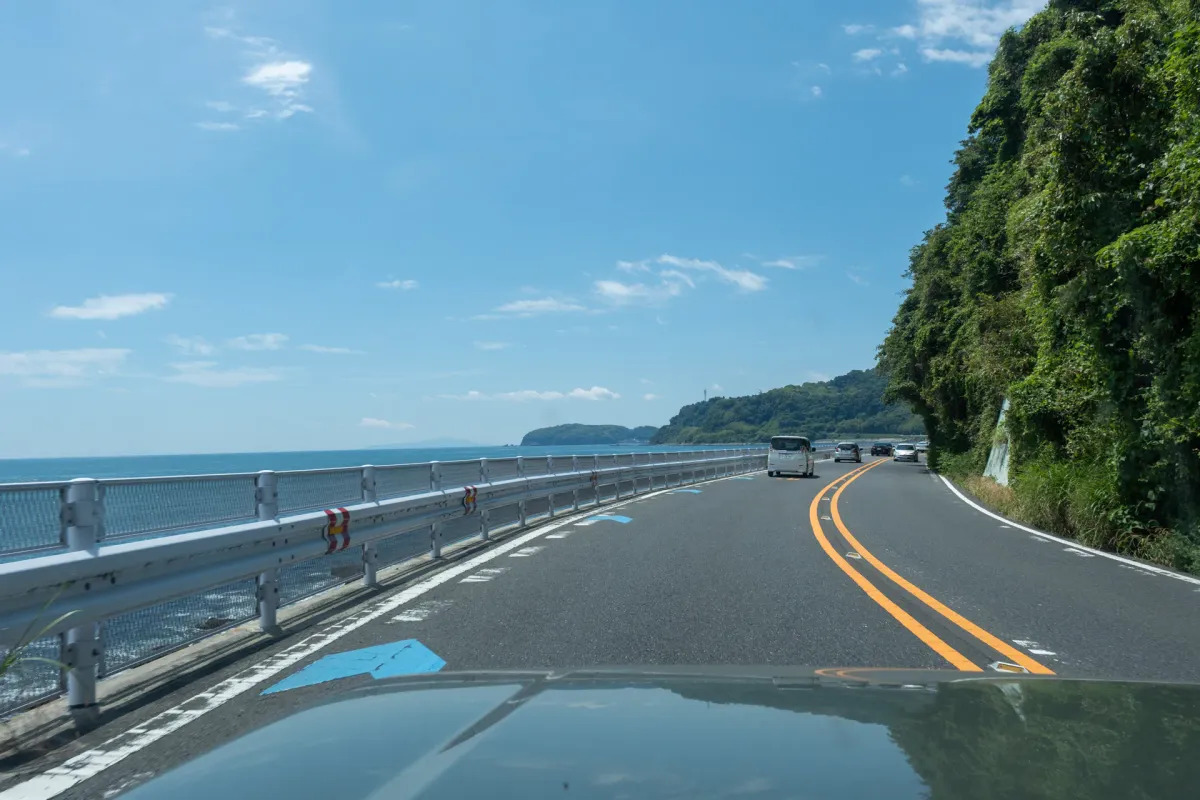
At the end of May, my husband and I took a 3-day road trip down to Izu. It’s a peninsula directly south of Mt Fuji in Shizuoka prefecture, and the main road runs right alongside the coastline, so you can enjoy some great seaside views, not to mention all the little caves and beaches you can check out along the way. To drive around the whole coastline of Izu - from Odawara to Numazu - is a little over 200km, and can technically be done in 6 hours. However realistically speaking, when you factor in all the little stops you make along the way, I would probably recommend giving yourself at least 5 days for a full circuit.
In our case since we only had 3 days, we chose to drive down the eastern coastline, getting as far south as the town of Shimoda. Then we cut inland across the peninsula and headed west towards the town of Matsuzaki, before driving up along the western coastline and back to our home in Tokyo.

We’ve previously done a camping road trip to Hokkaido, and had been talking about doing one down in Kyushu this year as well - but I figured with such a nice area to explore so close to Tokyo, it would be a waste not to give road-tripping Izu a go. And it made for a really nice weekend. I’ve recently been posting a bunch of mini posts about all the spots we visited, so this final one serves as a bit of a wrap-up in case you were interested in doing something similar.
Day 1: Cape Manazuru and the Jogasaki coast
My first piece of advice to you when heading out of Tokyo would be to leave early. The roads around the freeway on-ramps in inner Tokyo can get pretty congested. We took a pretty chill morning of it and left home at around 7:30, and then ended up getting stuck in an hour’s worth of traffic in the tunnels underneath Shinjuku. Not a great way to kick off the weekend, but I hadn’t actually done any planning for this trip (other than book the campsites), so it was a good opportunity for me to spend the time frantically scrolling around on Google Maps to figure out what we would be doing for the 3 days.
Our first stop was at the Ebina Service Area (a rest station on the highway) which is also the busiest Service Area in Japan. For some reason it’s popular for selling melon-pans and holds the Guinness World Record for selling the most freshly baked sweet breads in a 48-hour period (27,503).

I’m not really sure how it achieved this, other than it was a Golden Week weekend (one of the busiest holiday periods in the year) and I assume also they must have done a huge marketing push to try and get as many people to buy one as possible. Our opinion was that it was big for sure, compared to other melon-pans, but actually we probably prefer the taste of the ones you can get from a conbini.

Anyway, once we finally made it out of Tokyo and started our drive south down the coast, our first stop was in the town of Manazuru. This is the first point of interest on the drive, but technically isn’t on the Izu Peninsula - it’s still in Kanagawa prefecture. To be honest we didn’t have any intent on stopping, but our interest was piqued by some signs for Cape Manazuru, so we decided to take a short detour.

By this point we were quite hungry, but Manazuru is a tiny little town (population ~6000). So after the cape we headed a bit further down the coast for lunch at Shokuji-dokoro Matsui (食事処 まつい) in Yugawara. This is still not yet Izu!

Since we were by the coast, my only strategy for this was to search for a 海鮮丼 (kaisen-don, “seafood bowl”) on Google and see what would pop up, but I ended up finding a pretty good place.

Once back on the road, we finally crossed the prefectural border into Shizuoka as we passed through the town of Atami. Officially now we were in Izu.

Atami is quite a popular town - well, large enough at least to have 10-storey tall buildings (which seems quite rare in Izu). If you’re looking for a hike there, by the way, Mt Jukkoku (十国峠) is a popular one which I haven’t gotten around to writing about on this blog. It’s also home to a Hundred Famous Mountain, Mt Amagi. And of course there are plenty of seafood options in the area.
Atami also has the Atami Castle which you can spot on a hill overlooking the town. I ribbed my husband about how it’s sort of similar to his hometown Shimane’s Matsue Castle - which of course he immediately rejected - as Matsue’s one was built in the early 1600s, while Atami’s is a “fake” one built in 1959 and it would be rude to even compare it (ha).
Along the way I found one coffee bean roaster (yay) called Itoku Coffee so we stopped by to buy some of their beans. Quite close by to that was our campsite, the Kusamakura Camping Ground, where we checked in and then went for a quick walk around the Jogasaki Coast.
I’m not sure what the shower situation is like camping in other countries, but the great thing about Japan is that in rural areas you are never far from an onsen. Our onsen choice for the night was this Izu-kogen-no-yu onsen.

The entrance is a little creepy if you’re driving by at night, but their selling point is that they have free mud masks you can apply, which I’ve never seen at an onsen before. Of course you can’t take your phones into an onsen (there are naked people everywhere) but they had a camera machine set up near the mud masks where you could take a selfie of your face covered in mud, and then get the image later from reception (I dunno, sounds risky).

Otherwise though the onsen was quite comfy and had a huge stack of mangas.
Day 2: Mt Omuro, Shimoda, Cape Tsumeki
The next morning we were woken up at the crack of dawn by screeching crows, said goodbye to the gorilla near our campsite and then were on our way.

We bee-lined it to Mt Omuro. I was quite excited to “climb” (well, walk) this mountain. Actually when I first started dating my husband we made a day trip drive down here to Mt Omuro… only to find that the chair lifts up to the summit were closed due to strong winds. This time for round two we had much better luck with the weather.
With the peak of Mt Omuro checked off, we headed down the coast. Our main goal was to try and make it to the southernmost tip of Izu at Cape Irozaki.

I just want to mention that there was an absolutely gorgeous beach - Shirahama Beach that we passed along the way. It looked pretty popular though (with expensive parking fees) so we didn’t stop to get a closer look.

We also passed by the town of Shimoda, where we decided to stop for lunch. To be honest, I didn’t know a single thing about Shimoda, other than it seemed to have a cool coffee place called Coffee House Kahikan. As it turns out, it’s a rather famous little town, known for being the first port opened to trade with the US.
Near to Shimoda is also Cape Tsumeki, and after checking that out it was already mid-afternoon so we ditched our plans to make it to the southernmost point of Izu, and instead cut across the peninsula to the town of Matsuzaki and our campground at Nishiizu Auto Camping Ground for the night.

Day 3: Tombolo Land Bridge, Toi Gold mine, Shuzenji
We kicked off our final day with a spooky visit to the Muroiwa cave. This one was so random - there was basically no one there - so we got to enjoy the cave together with the bats. Then while we were there, we stopped by the tiny town of Matsuzaki, spotted a new species of sparrow, and then continued up the coast to the Tombolo Land Bridge.
The other cool part about the drive up the western coast of Izu was that that Mt Fuji will pop his head out at times.

If you want, you can stop off at Lover’s Point, or there is a random viewpoint here where you can get a nice view of Mt Fuji as well.

Our second-to-last spot for the day was the town of Toi, home to Izu’s gold mines, where we got a personal tour of a mine from an old grandpa. After this, we decided to call it and just head on home, but we realised that we would be directly passing through the town of Shuzenji so we made one final stop there to wrap-up our roadtrip.

On our drive home we noticed there was horrible traffic on the highway ahead (classic Tokyo experience, really) so to get out of that we took a nap in the car and had dinner at a service station. If you own a car in Tokyo, I’d recommend keeping a spare pillow in your car at all times in case such a need arises.
My husband also got a craving to buy a conbini melon-pan from Lawson, and together we confirmed that it tasted better than the Guinness World Record-holding one that we got on day 1 at Ebina.

Izu roadtrip: 3-day itinerary
As a bit of a recap, here’s a rough itinerary and all the places we visited in Izu over the 3 days, plus some places I had bookmarked but didn’t have the time to check out:
Day 1
- Cape Manazuru: the first scenic coastal spot once you make the drive out of Tokyo and past Odawara. Nice to stretch your legs!
- Itoku Coffee: for coffee-lovers
- Jogasaki Coast: a super-popular spot in Izu with scenic views
- Kusamakura Camping ground: conveniently right next to the Jogasaki Coast
Day 2
- Mt Omuro: a great little mountain with views of Mt Fuji. it seems the lines for the chairlift can get long on weekends, so we went a bit before its opening time of 9am. You might do this on day 1 depending on which day has better odds of seeing Mt Fuji
- Shimoda: a town with a rather significant bit of history, although it was quieter than I was expecting
- Coffee House Kahikan: a cute Showa-era coffee shop in Shimoda
- Cape Tsumeki: another scenic cape, right near Shimoda
Heading a bit further south, if you happened to come in late February, it would definitely be worth checking out the town of Kawazu for its cherry blossoms. Another notable spot beyond Shimoda is the Ryugu Sea Cave, plus Cape Irozaki right at the southern end of Izu.
Instead we ended our day by driving across to the town of Matsuzaki and then a 20-minute drive inland to the Nishiizu Auto Camping Ground. Personally I would recommend staying by the coastline and finding a campsite there instead so you can enjoy the sunset. If you were to arrive earlier in Matsuzaki, you could also check out the Kumomi Shore or Ishibu Rice Terraces.
Day 3
- Muroiwa cave: So random but fun (with bats), bring a flashlight
- Matsuzaki: a super-quiet town right next to the cave. Not necessarily worth visiting in the morning (unless you want to spot some sparrows). But it could have been quite nice to stroll here and enjoy the sunset the night before.
- Tombolo Land Bridge: a land-bridge that only forms if the tide has receded. This is cool if you can walk across it, but otherwise is just a quick photo opportunity and then you can move on. There is also the option to do a Dogashima boat cruise here instead.
It may be cool to also check out Tombolo on day 2 to enjoy the sunset and/or see how the scenery changes as the tide goes in/out compared to day 3.
- Toi Gold mine: a quick stop if you are interested. We didn’t head up to the town of Heda above it, but that may also be worth checking out for the Mt Fuji views
- Shuzenji: as you head inland back towards Tokyo, you’ll naturally pass this shrine and temple spot so it’s worth a quick stop.
We didn’t check out Mt Daruma, but that would be next on my list if I were to come back again. We also didn’t have much time to explore any of the middle of Izu, but next on my list to visit would be the Joren falls and Kawazu Seven Waterfalls.
Comments
You can also see all the places I visited on this map! www.emgoto.com/map/izu/ Tbh if I didn't have the map I probably would have just done 1 post for the whole thing and called it a day. But the map weirdly incentivises me to want to properly mark down all the places that I've been.
I was that close to head up to Shimoda during my trip because I read there's some surfing there, but it didn't work out. Cool to read a story about the Izu Peninsula instead!
Nice, im surprised, wouldn't it still be a bit cold for surfing?
Leave a comment