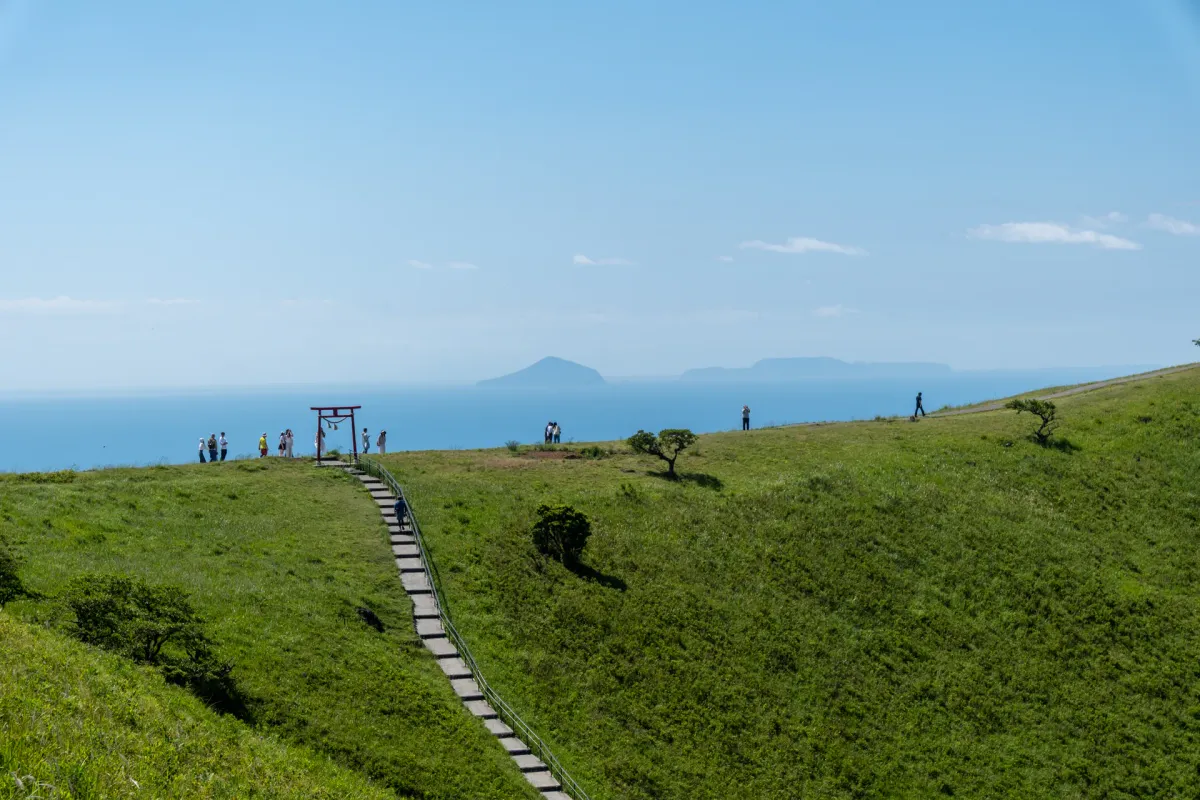
Mt Omuro is a 580m tall grassy peak on the Izu Peninsula with a rather cute conical shape. A former volcano - now extinct - it last erupted 4000 years ago and the resulting lava flow created what is now known as the Jogasaki Coast. Unlike most mountains in Japan which you can climb with your own feet, the peak of Mt Omuro is accessible only via chairlift. Once at the top, you can complete a loop around the crater rim in under an hour.
Hiking Mt Omuro: a quick summary
About 1.5 - 2 hours from Tokyo to Ito station via the Odoriko limited express or local trains, then a further 30 - 40 minute bus ride to the Shaboten Koen bus stop at the foot of the chairlift.
- Mt Omuro crater rim loopeasyBus + Chairlift0.5 hrs·0.9 km·↑ 62m

Since you get to the peak via chairlift, it’s not really a hike - but Mt Omuro genuinely is such a pretty little mountain, and the views from the top are amazing too. You can see down to the town below, the sea stretching out beyond that, and even Mt Fuji in the distance if you are lucky with the weather.
I don’t like to rely on luck though so I made use of this rather reliable Mt Fuji visibility forecast to time this hike. It’s a popular tourist attraction so even though we stopped by about 15 minutes before the chairlift opening time of 9am, there was already a bit of a line going.


Of course even with good Fuji visibility, if the winds are strong the lifts won’t be operating and you won’t be able to get to the top of Mt Omuro at all. Which is exactly what happened to us the last time we tried to visit here nearly 3 years ago. Luckily this time we didn’t have that problem.
Once the lifts started moving at 9am, we got on in about 10 minutes.

From the top, we got a lovely view of Mt Fuji in the distance.

Down one slope, you can also see the Izu Shaboten Zoo. Even from this distance we could hear the echoing cry of some sort of bird (peacocks?)

The zoo is most famous for their iconic onsen-bathing Capybara, and has a lot of free-roaming animals as well. Of course with most zoos in Japan, the animal welfare standards may be a little dubious (notably they have owls out in the open, tethered to a perch with a rope) so we didn’t bother to check it out.
Out towards the sea, you can see the island of Izu-Oshima.


At the very bottom of the crater is a large grassy field. This is off limits, unless you sign up for some archery (yes, really).


But you are allowed to head partway down into the crater to visit its Sengen Shrine, built in 1654.

I never knew this, but in total there are 1300 Sengen Shrines (浅間神社), mostly at places with a view of Mt Fuji. These shrines usually worship Konohanasakuya-hime, the deity of Mt Fuji. In Mt Omuro’s case however, the shrine worships her older sister, Iwanaga-hime.
For a bit of a messy backstory, Konohanasakuya-hime and Iwanaga-hime were both offered as marriage prospects to a God named Ninigi. But Ninigi turned Iwanaga down as he thought she was too ugly. Since Iwanaga is the goddess of immortality, Ninigi’s descendants (the future Emperors of Japan) were then cursed to live short lives.
Completely unrelated to anything, but through this Wikipedia rabbit hole I also discovered the work of Ella Du Cane who travelled to Japan at the beginning of the 20th century and did some rather lovely watercolours. (I’d never heard of her, but even Queen Victoria bought some of her paintings).

On one side of the crater rim was some Jizo statues facing the ocean. These were said to have been put up by fisherman to pray for maritime safety.


Just about on the opposite side of the crater to the Jizo statues were also some Buddhist statues. In the 17th century, it’s said that a fisherman by the name of Asakura Seibei came here after his daughter got pregnant to pray for his daughter’s safe childbirth. After his daughter safely gave birth, he had these statues carved from the stone at Manazuru, shipped to Jogasaki and then carried up the mountain to be placed here in gratitude.

Oh and by the way, his daughter who gave birth was 9 years old. (Poor girl).
I tried to figure out why exactly people would come to pray for safe childbirth here, considering Iwanaga is the goddess of immortality. It is said that in Izu, it’s believed that Iwanaga gave birth at Mt Omuro after being rejected by Ninigi (implying that he slept with her first?)
This is noted on Wikipedia and the source for this is noted as “the information board at shrine” which is kind of funny. Another Japanese blogger also notes how it was said that you shouldn’t talk about Mt Fuji while on Mt Omuro - as that will sadden Iwanaga (as it reminds her of her sister, and of being rejected by Ninigi).


After completing the crater rim loop, of course I needed to stop off for an obligatory peak marker photo.


And then it was back down we go.


Getting back to the carpark, the line had gotten much longer.

The one pity about Mt Omuro is that it has such a unique conical shape, but there’s not really a vantage point from which you can actually see it in its full glory - I think you need a drone or a helicopter to get a shot like this.

If you want to get in your conical mountain fix though, I would recommend Mt Azuma-kofuji up in Fukushima, as that has a pretty similar appearance.
Hiking course options
From the top of the chairlift, you can complete a loop around the crater rim in under an hour.
When to hike Mt Omuro
Mt Omuro is only accessible via its chairlift, which runs between 9am to 5pm (last ride to the top is at 4pm) in the warmer months, and 9am to 4pm in winter. If it’s a super-windy day, the chairlift will be closed as well so keep that in mind. A round-trip ticket costs 1000 yen. You can check the lift operating times here and it would be worth double-checking that it is running, as it can close due to maintenance (notably it is closed between the 15th - 25th of June as of writing this).
Mt Omuro looks so beautiful with its vivid green colour that I would encourage you to hike it during the late spring to early summer months if you can. However if you want to check it out in its yellow winter variant, the upside is that you probably will get the clearest views of Mt Fuji (as visibility conditions are better in the cold winter months).
It is also known for its mountain-burning festival held on the second Sunday of February where they burn off the dead grass on the mountain (which must be such a sight). A park at the foot of the mountain is also a popular cherry blossom spot in late March to early April, which would be another great time to visit.
Public transport access
Google Maps does a pretty good job of outlining your options to visit Izu, and since it is a bit of a tourist spot the public transport options are rather reasonable.
To visit Mt Omuro via public transport, you’ll first need to get to Ito station, which can be accessed either via:
- The Odoriko limited express (your seat must be booked) which takes 100 minutes between Tokyo and Ito
- A ride on the local Atami and Ito lines, which will take a little over 2 hours between Tokyo and Ito
There are then local buses running that will take 30 - 40 minutes to the “Shaboten Koen” bus stop (which is for the zoo just across the road from the Mt Omuro chairlift).
If you have the time, also checking out the Jogasaki Coast is a good idea as that is one of the other major attractions in the area.
Car access
We accessed Mt Omuro via car - there are a couple of rather large carparks, and parking is free. I would note that from Tokyo, it can be quicker to get down to Mt Omuro via train than it is via car, and you aren’t going to run into traffic either which is a plus. But it can be helpful to have a car if you want to hit up some other local sites in the area.

Read more
See other hikes nearby
Comments
Many thanks for the intriguing backstories of Omuro - the fact that Konosakuyahana had a rival was a revelation. A pity that one can't actually climb the mountain - wonder if the idea is to control erosion, or simply maximise profits at the chairlift....
Yes, I didn't know it at the time of the hike but it was fun to go down the Wikipedia rabbit-hole while I was writing up the post to figure out why the Buddha statues were there.
On climbing the mountain, I had that thought too - when you look at how green the mountain is though, I can imagine a hiking trail up the side of it might reduce that beauty by quite a bit (not to mention it might be hard to stop people stepping off the trail and making things worse). But I'm sure it must also be partially financial.
Amazing view from Mt Omuro! The first photo (featured image of the article) is really nice.
Thanks George!
Leave a comment